
For twenty years I told myself I was a conservationist because I put the fish back. That was the whole pitch. I fished stocked lakes loaded with pellet-raised trout, caught them on PowerBait and little spinners, held them just long enough for a photo that made me look tender, and slipped them back into the water like I’d done something holy.
You can save a fish and still be doing nothing for fish. It took me two decades and one very annoyed old man to figure out the difference.
The Fish Were Never the Point
The lake I fished most was a put-and-take pond. The state backed a truck up to the boat ramp every few weeks, dumped a few thousand hatchery rainbows out of a tank, and the crowd stood shoulder to shoulder on the bank pulling them out. Most folks used PowerBait or a worm under a bobber. The fish didn’t care. They’d spent their whole lives in a concrete raceway being fed pellets from a hopper, packed so tight their dorsal fins were worn down to nubs. A glob of fluorescent dough was the closest thing to home they’d ever known.
I thought I was above that crowd because I used a spinner. More sporting, I told myself. Real angling. The trout hit my Mepps just as eagerly as they hit the PowerBait guys’ dough, because a stocked rainbow will hit anything that moves. That should have told me something right there, and it didn’t.
I remember a kid at the ramp one spring who told me a trick: throw a couple handfuls of pea gravel out into the shallows and the trout will boil on it. They think it’s their pellets raining down. He was right. I watched grown men farm stockers that way, gravel in one hand, rod in the other, and I stood there feeling superior because at least I released mine.
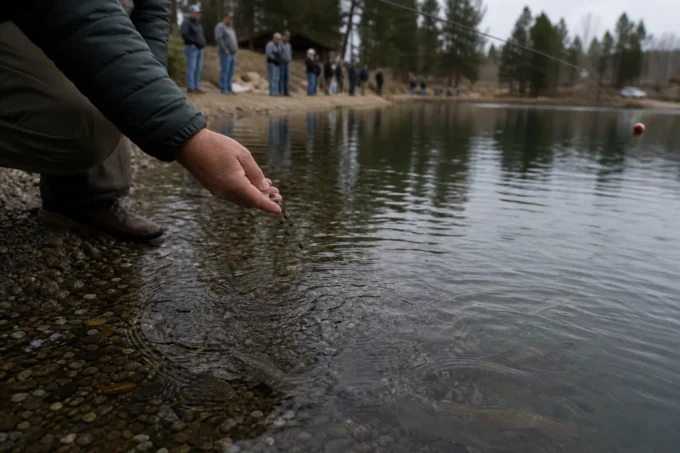
The Release Was Theater
Here’s what I never once asked myself in twenty years: where did this fish come from, and where is it going after I let it go?
The answer to the first question was a hatchery. The answer to the second was usually the bottom of the lake. I’d unhook a stocked rainbow with a ripped jaw and a worn fin, hold it in the water doing the little back-and-forth “revive” motion I’d seen on YouTube, and feel like a steward of the resource as it swam off. Half the time it floated back up belly-first twenty feet out. The other half, the guy twenty yards down the bank caught it ten minutes later and dropped it on a stringer.
That’s not conservation. That’s returning a hatchery-raised animal to a body of water it can’t reproduce in, so the state can back another truck up next month and do it all again. I wasn’t protecting a population. I was participating in a put-and-take conveyor belt and flattering myself that my small, careful slice of it meant anything.
An old man at the ramp finally said the thing out loud. I was unhooking a trout, being very gentle and very performative about it, and he watched me for a minute and said, “You know that one was born in a concrete trough ten days ago, right? You ain’t saving the wild. You’re catching the state’s dog food and throwing it back so they can restock the same factory fish again.”
I got defensive. I said something noble about respecting the fish. He shrugged and pointed at the creek that ran out of the back of the lake, the one I’d walked past a thousand times on my way to the ramp and never once fished. “The brookies in there been there since before your daddy was born,” he said. “Nobody stocks that. They make their own. You been polishing a rock for twenty years while the actual fish were right here the whole time.”

What Conservation Actually Looked Like
I fished that creek the next weekend. It was thin water, cold, full of overhanging brush that ate my lures. I caught one small brook trout all day, a wild fish with spots like wet stones, and I released it and it didn’t float belly-up. It shot back under a log like it owed me nothing. That felt different, and I couldn’t quite say why until later: the fish had somewhere to go, and a reason to be there. It belonged to the creek the way the stockers never belonged to that lake.
That’s when I started to understand what the actual conservation part even means. A hatchery fishery isn’t a wild fishery. Stockers are a product with fins. They exist so the state can sell licenses to people who want to catch something without the walk, and there’s nothing wrong with that as a managed experience, but calling it conservation because I let one go is a lie I told myself to feel good.
Real conservation is the boring stuff. It’s keeping the creek clean enough that native trout can spawn. It’s not wading through redds in the spring. It’s the planted riparian buffer upstream that shades the water so it doesn’t warm past what brook trout can survive. It’s showing up to the meeting when somebody wants to straighten the creek or run cattle through it or log right to the bank. It’s a wild fish reproducing on its own, generation after generation, with no truck and no hopper and no pea gravel.
I still fish the stocked lake. I’m not going to pretend I turned into some purist saint. But I don’t call it conservation anymore. I call it what it is, a trout social hour with a Walmart rod and dough that smells like strawberries. And when I want to be a stewarded part of something that was there before me and will be there after, I go to the creek, catch maybe one wild brook trout if I’m lucky, and put it back for a reason that isn’t about how it looks in a photograph.
You can’t save the wild by returning what the state farmed. You save the wild by leaving the wild, the actual wild, more alive than you found it. I had that backwards for twenty years, and I only got it straight because an old man got tired of watching me polish my rock.
