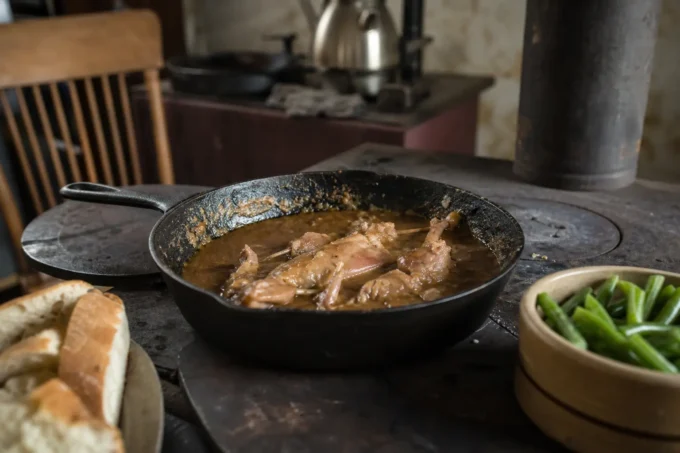
The page after Recipe No. 8 wouldn’t come loose, not clean. Three decades of dried gravy had glued it flat to the next one, and Amos’s biscuit recipe sat there sealed like a letter that never got mailed. I worked a butter knife along the seam for a good while, a sliver at a time, until the top sheet tore away and left behind the ghost of it. What was underneath, written in the same pencil that had dug itself a trench, read “RABBIT in the PAN GRAVY.” Amos had circled “PAN GRAVY” twice and drawn a small arrow to the word “RABBIT,” with one note in the margin: “easy on the flour, boy, a man aint makin wallpaper.”
Rabbits were the animal you got when you didn’t get anything else. A boy with a .22 and a pair of eyes could put meat on the table on a day when the coon traps were empty and the woodchucks had gone underground. The trouble with rabbit, as Amos saw it, was that there’s never quite enough of it, and the meat runs lean, so you had to make something out of whatever stuck to the bottom of the pan after the frying. He called it pan gravy, and he treated it like it was the whole reason you’d bothered to catch the rabbit in the first place.
Recipe No. 9: Rabbit in the Pan Gravy
Ingredients
- 1 young rabbit, cut into serving pieces (back legs, front legs, saddle)
- 3 tablespoons bacon fat or lard
- 1/3 cup flour, for dredging
- 1 onion, sliced thin
- Salt and black pepper
- 2 cups milk or water, cold
- 1 tablespoon flour, for the gravy
- A knob of butter (if you had it, which Amos mostly didn’t)
Procedure
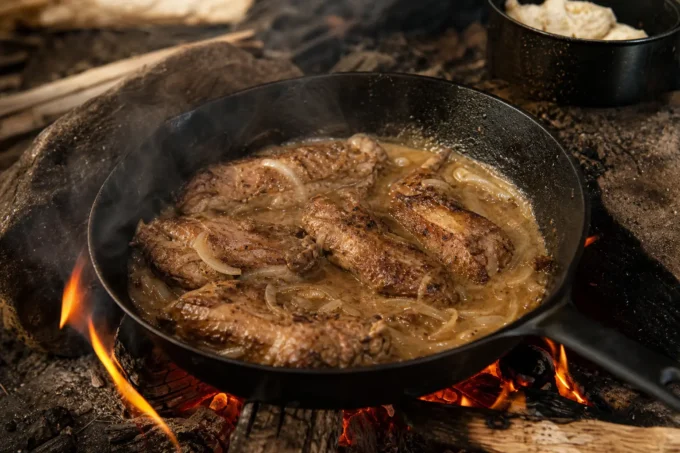
Step 1 — Get the pan hot. Melt the bacon fat in a big cast iron skillet over a fire that’s high enough to sizzle but not so high it smokes. Salt and pepper the rabbit pieces, then shake them in the dredging flour until they’re dusted all over. Shake off the loose flour, because loose flour is what turns the bottom of a skillet into a paste instead of a crust.
Step 2 — Fry the rabbit. Lay the pieces in the skillet without crowding them, and brown them hard on every side until the outside is deep gold and crisp at the edges. Rabbit wants more heat than you think, because the meat’s so lean it’ll dry out on you if you nurse it along on low. Pull the pieces out and set them on a plate to rest.
Amos’s note, scrawled under the browning line: “a rabbit aint got a lick of fat on him. you put that over a slow fire and you might as well fry a boot.”
Step 3 — Build the gravy. In the same skillet, with all those brown scrapings still on the bottom, cook the sliced onion in the leftover fat until it goes clear and soft. Sprinkle in the tablespoon of flour and stir it around for a couple minutes so the raw taste cooks out. Then pour in the cold milk or water slow, stirring the whole time so it picks up every bit off the bottom of the pan. Let it bubble and thicken until it coats the spoon. That brown stuck to the pan is what makes it taste like something.
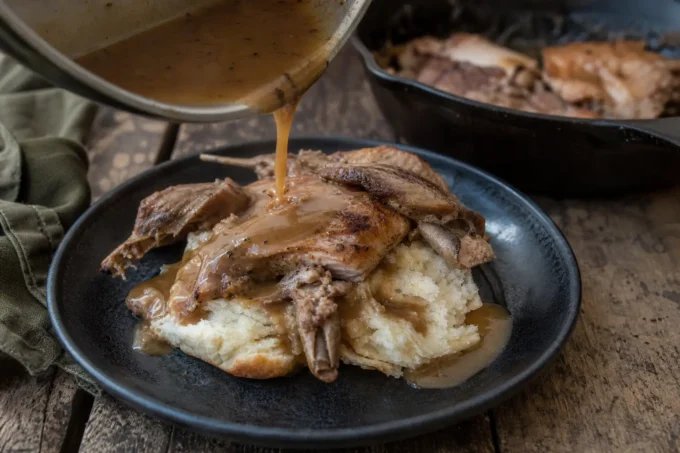
Step 4 — Put it back together. Slide the fried rabbit back into the skillet, spoon the gravy over the top, and let it all simmer low for twenty minutes or so until the meat is tender all the way through and the gravy has soaked into the crusty outside. Serve it over biscuits, over fried potatoes, or straight out of the pan if nobody’s watching.
Amos’s last line, written so small at the very bottom it looked almost ashamed of itself: “pan gravy aint hard, it aint fancy, it just aint somethin they sell in no store. that’s the whole point of it.”
What It Actually Tastes Like
The rabbit comes out with a crisp, browned shell around meat that stays mild and almost sweet, closer to the breast of a chicken than to any wild taste you’d brace for. The gravy is the payoff: thin and peppery and tasting of the pan, with that deep roasted note you only get from scrapings that’d otherwise go down the sink. Over biscuits it’ll finish the same way the woodchuck gravy did, like a warm brick dropped into your middle that says you’re fed and you’re fine.
Practical Notes
- Young rabbits fry tender. An old buck will fight you, so if the meat’s tough when you test it, simmer it a half hour longer in the gravy and let time do the work.
- The whole trick is the brown scrapings in the pan. Don’t wash that skillet while it’s hot, and don’t ever throw that out.
- You can fry this in butter instead of bacon fat if you’re flush, but Amos would’ve looked at you sideways for it.
- Seasons and bag limits on rabbits change state to state, so check before you load up, and keep an eye out for that one with the liver spots a man shouldn’t eat before a good frost.
Next from the folder: the seam where this page tore away left a sliver of the next one showing, and under the last line of Amos’s pan gravy note I could just make out the top of a capital letter and the word “BRINE.” Whatever it is, it’s got salt in it and a story behind it. We’ll get there.