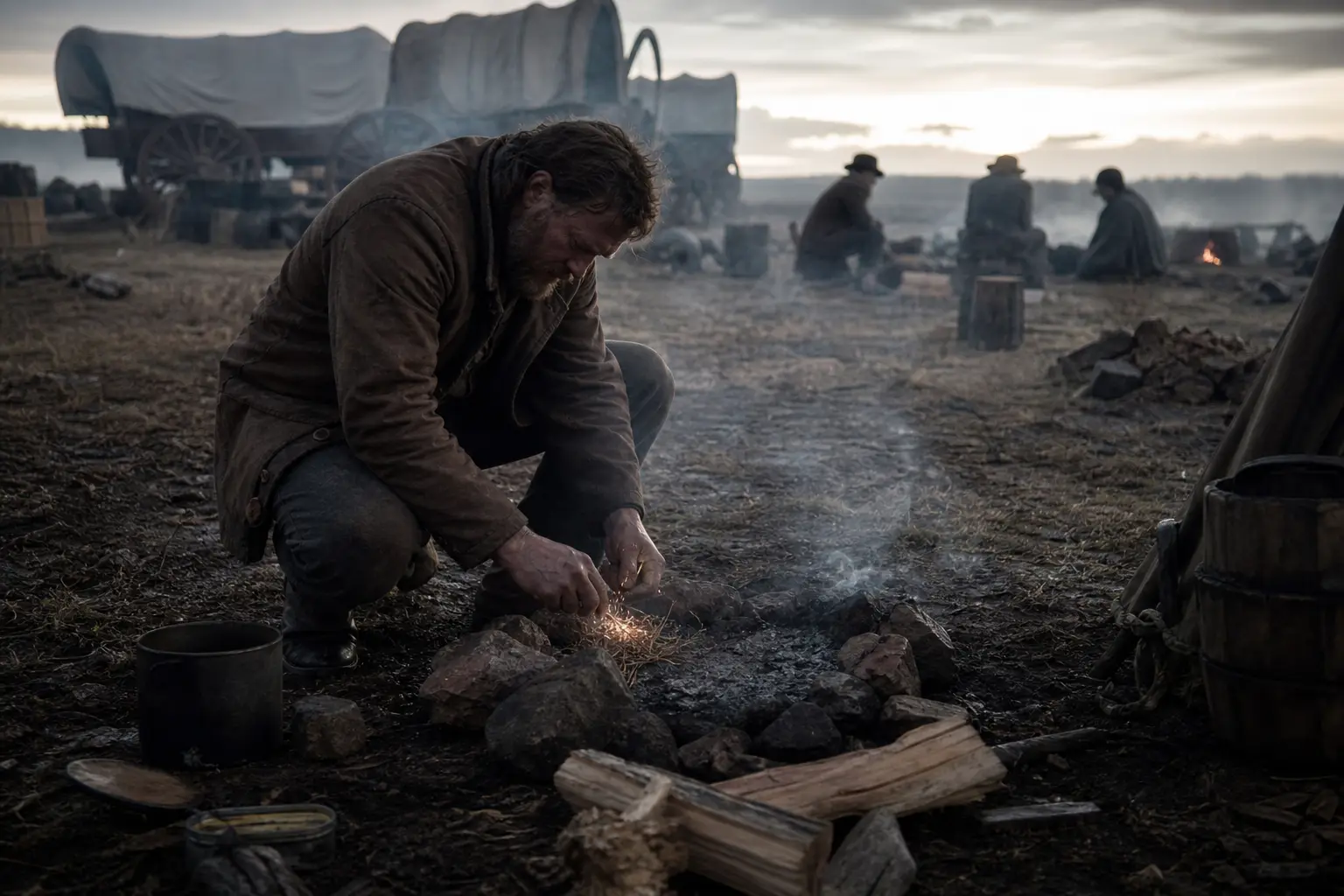
You wake because the cold has crawled through the wagon bed and settled in your chest. It is early April, 1846, somewhere west of the Missouri River, and the last of the coals have gone grey under their blanket of ash. You know before you lift the cloth what you will find. You lift it anyway. The coals are dead. Cold. Your fingers come away smelling of wet ash and cold iron, and behind you, in the wagon, your wife stirs and asks the one question you do not want to hear.
“Is the fire out?”
There is no answer that makes the morning easier. Across the circle of wagons, Tom Miller is already up, hunched over his own dead fire the way a man bends over a broken axle. His brother Joe sits nearby, wrapped in a blanket, coughing a dry cough. Old man Morrison has not risen at all. Morrison has been getting slower for two days now, and you have watched his hands shake so badly in the mornings that he cannot grip his own cup. Nobody says it out loud, but everybody is doing the same arithmetic. No fire means no coffee, no hot food, no heat, and tonight, no protection against the things that come sniffing at the edge of the light when it goes dark.
So it falls to you. It always falls to you, because you are the one who carries the tinderbox inside your coat, the little tin box with the flint and the steel and the scrap of charred cloth folded in the bottom like a secret. You reach for it and your fingers are stiff with cold, and that is the first thing you learn that morning: fire started in a hurry is fire that goes out twice before it catches. The second thing you learn is worse, and it comes when you open the tin and see how little char cloth is left.
The third thing is the wind.
The Coal You Must Not Lose
Here is the whole problem, stripped down to its bones. On the trail, you do not actually start a new fire every morning. You carry fire. Every night, before you sleep, you drag a thick log or a buried knot into the coals and cover the whole thing in ash, so that it smolders slow and low while you rest. In the morning you scrape away the ash, blow on the buried glow, and feed it a handful of dry grass and little twigs, and the fire comes back. It is not glamorous. It is the most important chore you have, because it means you never have to strike steel in the rain.
Last night the wind got into it. You know this because the ash blanket was thin on the windward side, and the coals burned too bright and burned themselves out before dawn. You should have checked before you lay down. You were tired. Tired is how the fire dies.
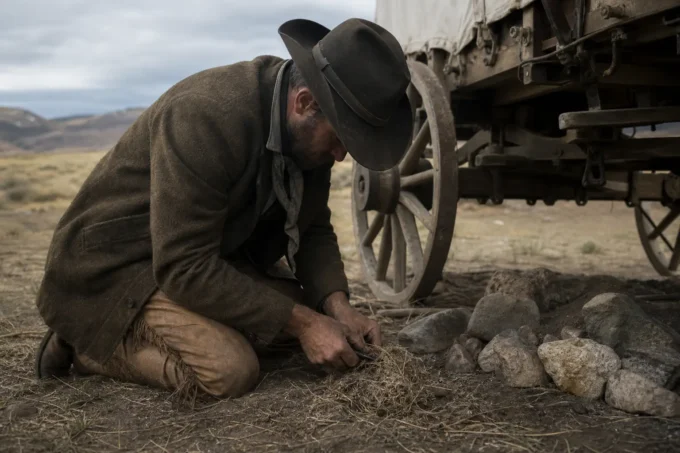
Now you must do it the hard way, in a wind that finds every gap in your coat and whistles through it. You kneel in the lee of the wagon and begin to build a bird’s nest of dead grass and the dry inner bark you stripped yesterday from a cottonwood. You fray the bark with your thumbnail until it is soft as hair. Then you take the steel in one hand and the flint in the other, and you strike.
The first strike throws sparks. They scatter and die on the wind. The second strike does the same. Your third strike is the good one, a long bright spray that lands on the patch of char cloth, and for one heartbeat a little orange eye opens in the black cloth. You cup your hands around it, and the wind finds the crack between your thumbs, and the eye goes out.
How You Actually Do It
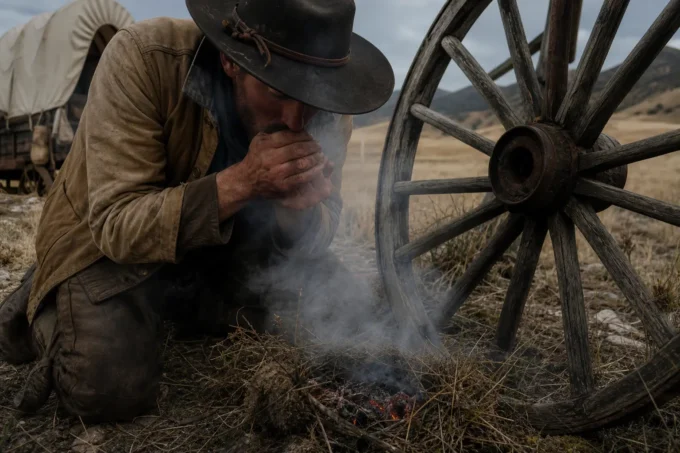
You start over, and this time you do it the right way, which is slower and uglier than you want it to be. You build a small wall of your own body and the wagon wheel against the wind. You fold the burning coal into the heart of the bird’s nest, not on top of it, and you hold the whole bundle up near your mouth and blow. Not hard. A soft, steady breath, low and even, like a man coaxing, not commanding. The smoke curls up and makes your eyes water, and the grass in the nest begins to whisper as the fire takes hold.
You feed it in order, the order that matters more than anything you own: spark into char, char into tinder, tinder into shavings, shavings into twigs the thickness of a match, twigs into branches the thickness of your thumb. Every fuel wants the one before it to be solid and alive before it will catch. Rush it and you smother it. Starve it and it starves. You have learned this by ruining a hundred fires in the rain, and your knees are wet and aching by the time the flames finally stand up on their own, orange and hungry, in the shelter of the wheel.
Your wife comes out of the wagon with the coffee pot, and she does not say thank you, because there is no thank you for the thing that keeps you all alive. She just sets the pot in the coals and goes back for the dried meat and the last of the cornmeal. Tom Miller walks over and stands close to the warmth, holding his red hands out, and the two of you do not speak. Some mornings the best conversation on the trail is the sound of a fire eating wood.
What Gets Harder
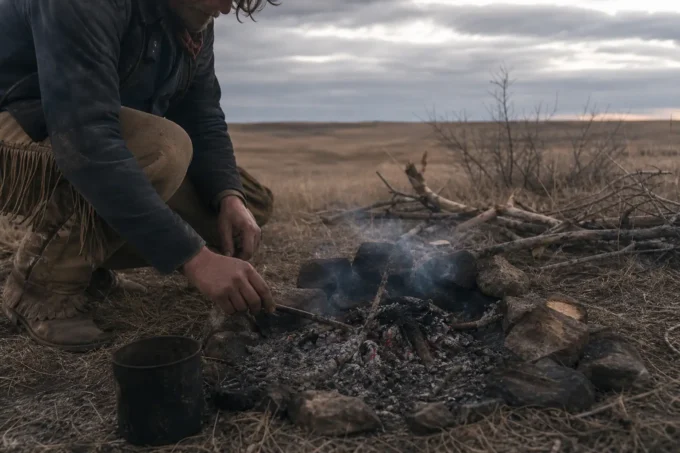
The trouble is not over when the flames are up. The trouble with fire on the prairie is that it is always leaving. Wood is scarce past the Missouri, and what little you find is willow and cottonwood, which burn fast and throw less heat than the oak your grandfather split back in Missouri. You spend an hour a day scrounging enough to last the night, and some days you walk two miles to a creek line and come back with an armload of green sticks that hiss and steam and refuse to catch. Buffalo chips dry in the sun and burn, but they stink and leave a fine ash on the food, and nobody likes the taste of a prairie fire in their coffee.
Then there are the things that want to kill the fire for you. The wind, always the wind, which flattens your little flame against the ground. The rain, which only has to show up once to turn every stick you gathered into wet sponge. And the cold, the long prairie cold that makes a man’s hands so numb he cannot strike steel at all, and then the fire you needed to survive is the very thing you can no longer start.
In the afternoon Morrison finally gets up. He stands at the edge of the fire and urinates into the dirt, swaying a little, and you watch him and think about the fires back east, the fat kitchen stoves and the coal and the people who never once in their lives had to choose between burning the last dry wood for a supper that might not come and saving it for a morning that might be colder. You do not envy them. You cannot afford to. You just think about them the way a man thinks about a warm room he no longer lives in.
The Night the Wolves Get Closer
That night the wind turns and brings the smell of rain. The sky goes the color of old pewter, and you know the storm will hit before midnight. So you burn your hoard. You feed the fire all the dry wood you saved, because a fire you will not have in the morning is worth more than two armloads of wet sticks. The flames climb high and push the dark back into a ring of orange light, and the children sit closer and the adults sit closer still, and the whole circle of wagons leans toward that one bright center.
The rain comes down hard around midnight and the fire hisses and you and Tom Miller scramble to move the coals under the bed of the wagon and pile every wet blanket you own over the wood. You save a single buried coal. You guard it the way you would guard a child, feeding it tiny dry splinters under the shelter of your cupped hands, while the rain drums on the canvas above you. You do not sleep.
By dawn the rain has stopped and the coal is still alive, and that one orange ember, smaller than your thumbnail, is the reason the coffee boils and the children stop crying and the day starts at all. It is the most tired a victory has ever made you. You just want to sit down. The truth of the frontier, the truth nobody writes on the side of a wagon, is that the man who keeps a fire alive has done the most important work of the day and has nothing to show for it but a handful of grey ash and a wife who hands him a cup without a word.
What Was Real
Fire on the overland trails was a daily, life-or-death necessity, and starting it was almost never done with a match. The friction match we know today was still in its infancy in the 1840s. Early “lucifer” matches were unreliable, sometimes poisonous to make, and often too fragile or too costly to carry as a primary tool. The standard for emigrants moving west was flint and steel, a carbon steel striker struck against a sharp flint edge to throw hot sparks.
The spark alone was not enough. It had to land on char cloth, or charred linen or punk wood, which had been cooked inside a tin or in a smothered fire until it became a black, oxygen-hungry material that would catch a spark and hold it as a slow, glowing coal. That glowing coal was then folded into a bird’s nest of dry tinder, typically dried grass, cedar bark, cottonwood inner bark, or cattail fluff, and coaxed into flame by steady breath. The whole system fit in a tinderbox, a small tin carried in a coat pocket against the body, because dry char and dry tinder were worth more than the flint itself.
The idea of “carrying fire” rather than starting it fresh was real and universal. Emigrants banked their fires at night by burying coals in ash and keeping a slow smolder alive, precisely so they would not have to strike steel in the wet and wind of a prairie morning. Losing the banked coals overnight was a genuine setback, and on cold, wet, or windy days, relighting a fire was a serious and sometimes painful struggle.
Fuel was scarce and precious west of the Missouri River, and wood became progressively harder to find as the trail climbed into the high plains and deserts. Emigrants burned willow and cottonwood where they could find it, gathered windfall along creek bottoms, and increasingly relied on dried bison dung, called buffalo chips or bois de vache, as the trees gave out. Buffalo chips burned adequately when dry but smelled foul and coated food and coffee in fine ash. The scarcity of fuel shaped the daily rhythm of the journey, and collecting enough wood or chips to last a night was a standing chore every family knew.
The Oregon Trail saw its great migration between roughly 1843 and 1869, with an estimated 400,000 people making the crossing. For all of them, fire was heat, light, cooking, and protection from predators and the dark, and keeping a single coal alive could be the difference between a miserable morning and a dangerous one. The skill was so central that a well-kept tinderbox, a sharp flint, and a dry bit of char were among the most valued small possessions a traveler carried.