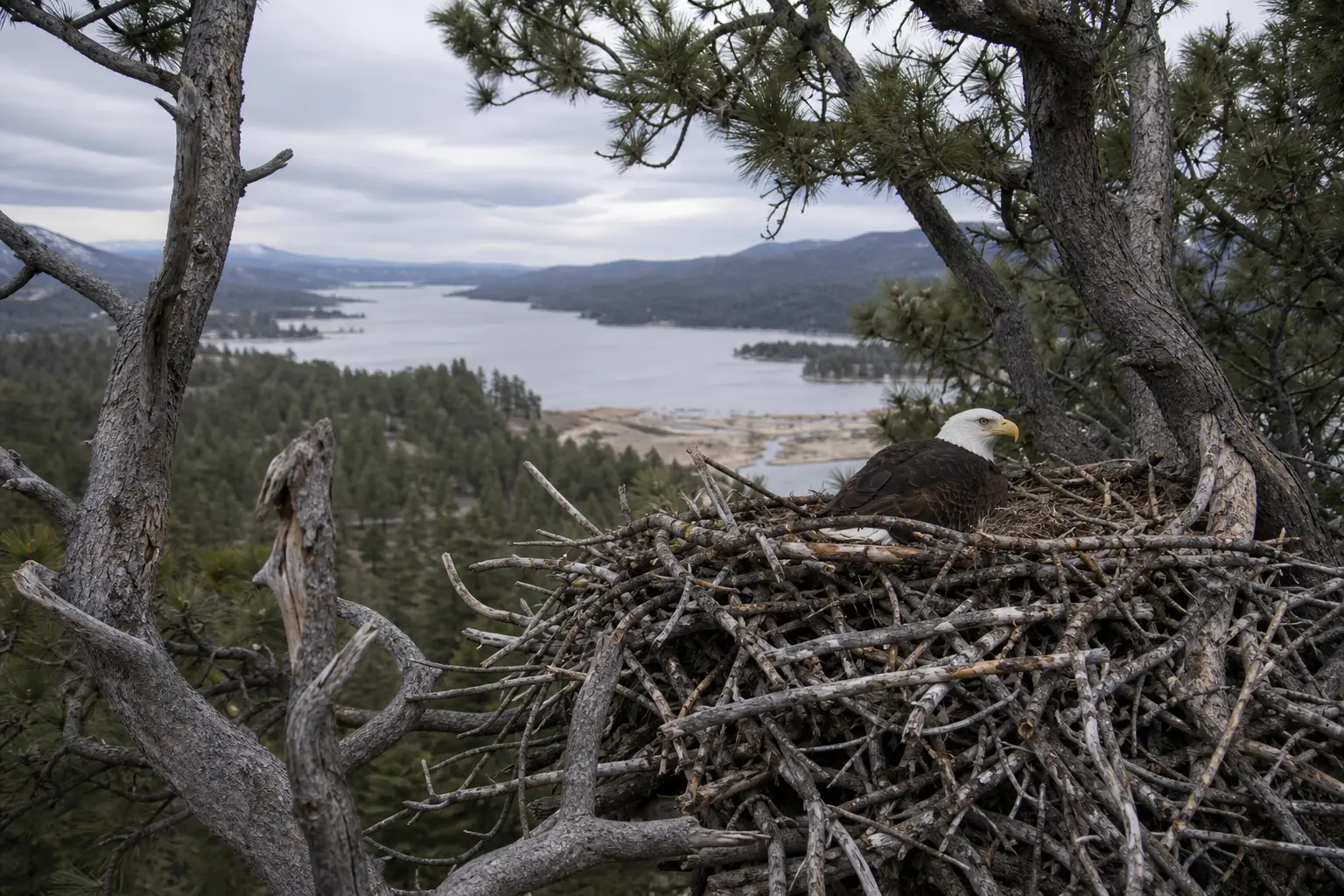
She started out as Jack.
That is the detail people forget when they talk about Jackie, the bald eagle from Big Bear Valley, the one whose nest cam turned her into something close to a household name. Before she was Jackie the matriarch, before the snowstorms and the late-night feedings and the fifty-four thousand name suggestions, she was just Jack. The first bald eagle chick anyone had ever confirmed hatching in Big Bear Valley, back in 2012.
No one could know yet what she would become, because no one had ever watched an eagle this closely before. She was not banded. Her parents were believed to be a pair the watchers called Ricky and Lucy, though even that was phrased carefully, the way people phrase things when they are not entirely sure. She fledged that April. And then, like most wild birds, she vanished into the wide world, and for a while the story should have ended there.
The Return
Except she came back.
That is the part that turns a small local story into something with a spine. Years later, Jackie took over the very territory where she herself had grown up. The nest that Ricky and Lucy had built, a hundred and forty-five feet up a Jeffrey pine, became hers. Not a nest like it, down the valley. The nest. The one on the camera. The one that millions of people would eventually watch every single day.
She came back to a place, and she stayed, and she built. The watchers at Friends of Big Bear Valley, the group that ran the camera, kept count the way careful people keep count. They estimated the pair brought in somewhere between six and nine hundred sticks a year. The nest grew past five and a half feet wide and six feet deep. A wild animal building a house in front of a live audience, one branch at a time.
Shadow Was Not the First
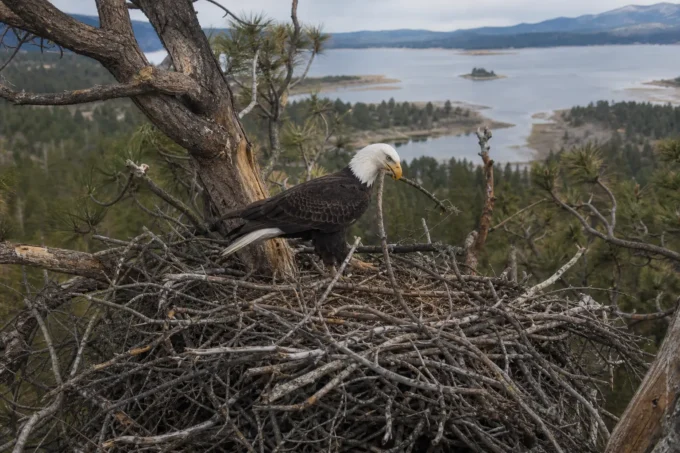
Most people who know Jackie know Shadow, the big dark eagle who sat beside her through the hard years. Fewer remember that Shadow was not the first male in her life. Before him there was another eagle the watchers called Mr. B. In 2018 it was Mr. B with Jackie on that nest, and together they raised two chicks: Stormy, who fledged, and Big Bear Baby, who did not. The chick died, probably of hypothermia, during a stretch of rain and cold.
Wild birds do not leave the kind of paper trail people do, so most of Mr. B’s story simply went unwatched. He was not banded. When Shadow took over the territory later that same year, nobody could say where Mr. B went, or whether he lived, or whether he simply flew off into the same wide world Jackie had once disappeared into. The record just shifts, the way an eagle’s life does, and you are left with only the parts somebody happened to be filming.
The Ledger of Loss
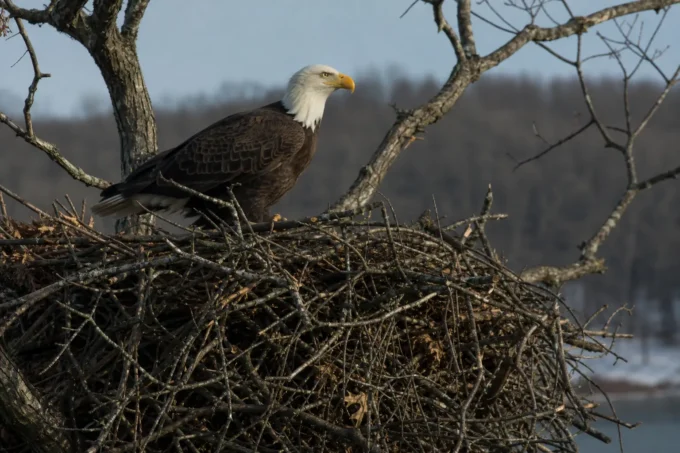
Here is what watching a wild eagle for years actually looks like, and it is not a nature documentary. It is a ledger, and a brutal one.
In 2019 Jackie raised Simba and Cookie. Cookie died in a storm. Simba fledged. Later, Friends of Big Bear Valley had to deliver the news that both Stormy and Simba, the two that had made it off the nest, had been found dead elsewhere in California, identified by the bands. No cause was ever announced. Two chicks you watched learn to fly, gone, and nobody could tell you why.
In 2022 came Spirit, who hatched and fledged clean, a rare bright spot. The second egg in that clutch never hatched, and over time the watchers watched it slowly become part of the nest itself, one more layer in that six-foot-deep house.
In 2023, two eggs, no chicks. In 2024, three eggs, Jackie’s first ever three-egg clutch, and none of them hatched. All through the El Nino storms that winter, Jackie held the nest. The watchers counted something close to sixty-two straight hours of her sitting on those eggs through the weather, and even after, she and Shadow kept incubating for nearly eighty days, long past the point any egg was going to hatch. You watch that and you understand that an eagle does not know when to give up.
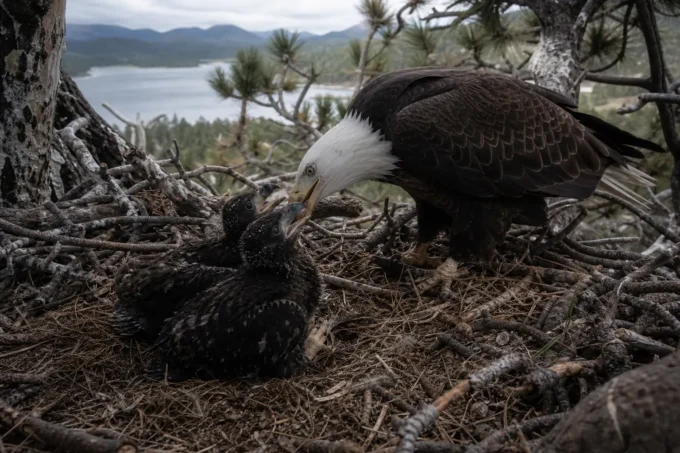
Then 2025, and all three eggs hatched. Misty, Sunny, Gizmo. The public sent in more than fifty-four thousand name suggestions, a number so large it tells you exactly how many people were watching. Misty died in a storm. Sunny and Gizmo fledged.
And in 2026, two more: Sandy and Luna. Named for the long-time head of Friends of Big Bear Valley, a woman named Sandy Steers, who died that February. There is something heavy in that, naming a fledgling eagle for a woman who spent decades protecting the place it would learn to fly from. When Jackie went into care that July, Shadow kept feeding Sandy and Luna alone. He did not leave. He fed the chicks and guarded the nest, the only way an eagle can say that one parent down does not mean the nest fails.
The Octopus Stick and Other Small Things
You do not become beloved in the abstract. You become beloved in the small, stupid, real moments, the ones no editor would ever pick out of a reel.
Jackie had a habit of hauling in branches that were far too big, the way a dog brings you a stick twice its own length. One of them got a nickname from the watchers: the octopus stick, on account of all the little branches sticking out of it. She rearranged that thing for close to half an hour, turning it this way and that, and later Shadow moved it again.
In May of 2026, one of her chicks hit her square with a shot of droppings. The watchers recorded it, because of course they did. That is what the camera gave people that no wildlife documentary ever could: not a highlight reel, but a continuous, unedited stream of a real life, the awkward and the ugly and the ordinary all in one place. Jackie was bigger than Shadow, with a flatter head and a brow ridge that gave her a stern look the watchers joked made her built like a linebacker.
None of it is remotely glamorous. It is also exactly why people loved her.
When the Camera Could No Longer Say What Was Happening
Then it was mid-July, and Jackie was gone from the nest.
It started with a report of a conflict with two other eagles. She was found weak, unable to fly off properly, and she was captured and taken to the Ojai Raptor Center, where she became Patient 26-519. Here is where the story changes shape, and I want to be careful with you, because being careful is the whole point.
The camera had shown people everything. Now there was no camera, only a vet. And a vet does not speak in the same language as a livestream. A vet talks about anemia, severe and recurring. About inflammation and abnormalities in the kidneys. About a large blood clot near the wing and the kidney. About other organ problems. About blood values that kept crashing.
They did the things you do when you are trying to save something that cannot tell you where it hurts. X-rays, looking for fish hooks or lead shot or metal, and finding none of it. A blood transfusion. Her packed cell volume was down around eight percent, and by late July it had climbed back to sixteen. She started eating on her own again and got more active, and for a moment it looked like she might pull through. It did not hold.
They took it further than most wildlife medicine ever gets. A contrast CT. A bone marrow biopsy. Heavy metal testing. Consultations with specialists around the country. The Ojai people and the state’s wildlife agency threw everything at a bird most of the world knew by name, and still the cause of the underlying disease stayed out of reach.
Maybe it was the fight with the two eagles. Maybe the fight only exposed something that was already going wrong inside her, the way a stumble reveals a weakness that has been there for weeks. Maybe lead, maybe a rodenticide, maybe a virus, maybe something nobody has named yet. I am not going to solve that for you, because nobody has solved it. Jackie died overnight between August 9 and 10, 2026, and as of this writing, the definitive cause of death has not been released.
There is a lesson in that, and it is uncomfortable. You can point a camera at something for ten straight years, know its every habit, name its chicks, cheer its storms. And then it dies in a clinic, and the people with the CT scans and the bone marrow biopsies still cannot tell you why. Not every story closes. Some of them just stop, with a question mark where the answer should be.
What She Left That We Can Touch
There is a detail at the very end that is so strange it nearly does not belong in a story about a beloved eagle. After the necropsy by the pathologists at San Diego Zoo Wildlife Alliance, Jackie’s remains are set to go to the National Eagle Repository, a federal facility run by the U.S. Fish and Wildlife Service. Under federal law, the bodies and feathers of bald and golden eagles are strictly controlled, and the repository exists to distribute them for the permitted religious and cultural use of Native Americans.
Read that again. The most-watched wild bird in America, an eagle people around the world felt they knew personally, does not end in a museum case or a memorial garden. Her body goes where the bodies of eagles are required to go, by law, into a system older and quieter than any of the fame. In death she becomes, again, simply an eagle.
The Land
And here, maybe, is the point the whole story has been bending toward.
For decades, a piece of ground called Moon Camp sat less than a mile from Jackie’s nest. Developers wanted to put luxury housing and marina slips on it, right in the middle of the foraging and perching country the eagles used. Friends of Big Bear Valley had been fighting that development since long before anyone pointed a camera at a nest, since the group first formed back in 2001. The fight dragged on for roughly twenty-five years.
Then, in 2025, the project got approved again. The campaign said more than five thousand protest emails went in. And in 2026, a path opened up to buy almost sixty-three acres outright, for ten million dollars, and protect it forever, with a deadline on the last day of July.
The timing lands hard. The fundraising closed, at better than ten and a half million dollars, in the very same stretch when Jackie was in intensive care. The people who could not save the bird still managed to save the place she had lived. A final donation of more than five and a half million dollars, from names you might recognize if you follow this kind of thing, pushed it over the line. Sixty-three acres, bought and protected, because enough people who had watched an eagle decided the ground under it mattered too.
There is no clean moral to hang on that, and I will not try to give you one. A wild eagle lived her whole life on camera, and then she died off it, and we still do not know why. But while she was fading in a clinic where all that technology could not save her, the same people who had watched her managed to do the one concrete thing that still could be done. They could not keep Jackie alive. They could keep the place she came from.
Millions of people watched a wild eagle live an entire life. Then, for the first time, the camera could not tell them what was happening. But the ground is still there. Some of it is protected now, for good, because an eagle we will never fully understand taught a whole lot of strangers to care about one small stretch of the San Bernardino Mountains.