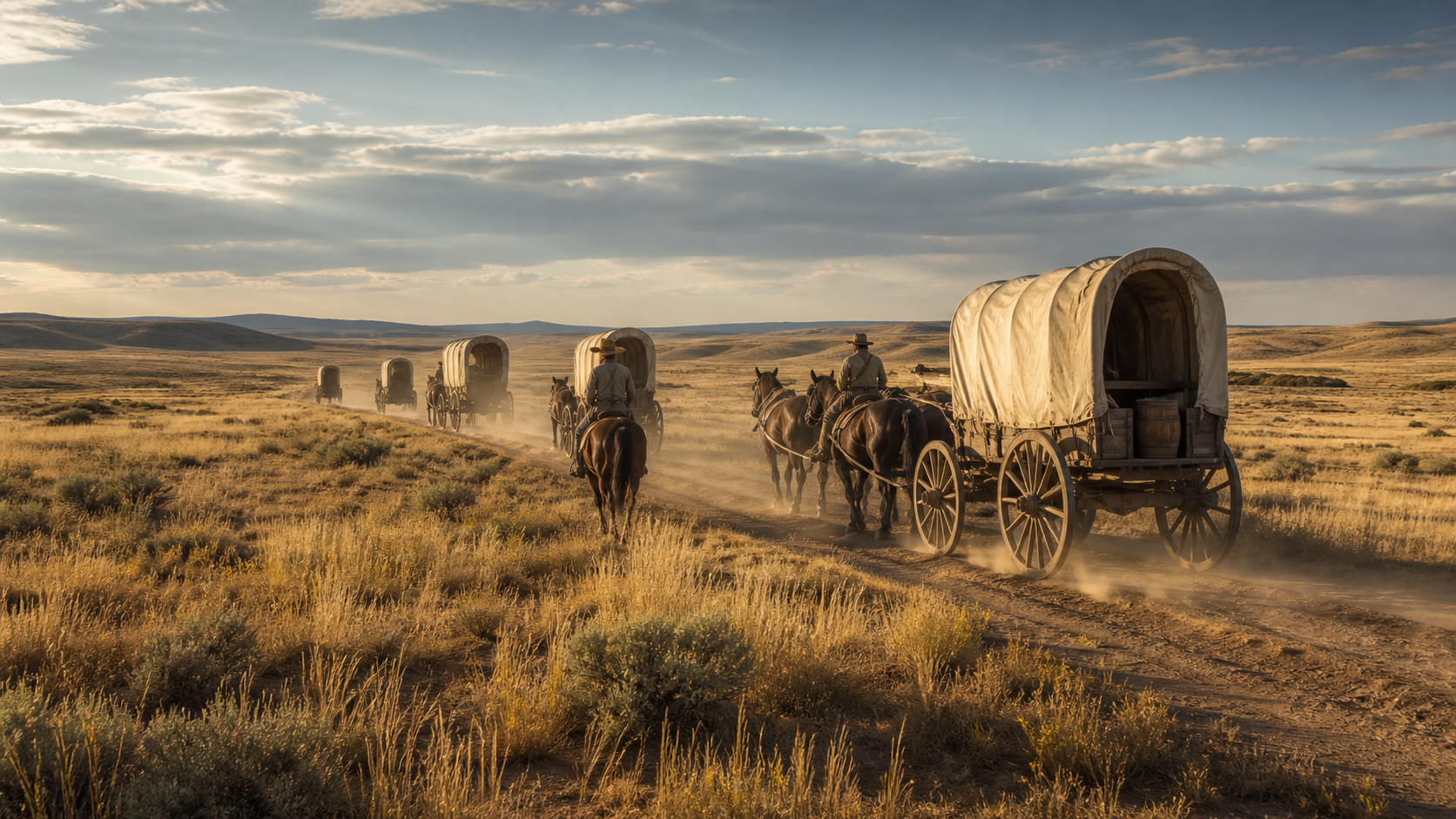
You wake up because a mosquito is drinking from the corner of your mouth. Late June, 1843. The canvas glows gray before dawn. Somewhere outside, the wagon master is coughing up dust and yesterday’s bacon. Tom Miller’s wife is already yelling at him for something. It’s always something.
Six weeks out from Independence. Somewhere in what people will call Nebraska. Yesterday the Millers’ boy shot a young cow that wandered too close. Now there’s two hundred pounds of meat spread across a blood-soaked tarp between the wagons and everyone is looking at you like you’re supposed to know what to do with it. John Morrison already gave up. He’s sitting against a wagon wheel with a bottle of whiskey, watching the meat start to turn in the morning heat. His wife won’t look at him anymore. You saw her walk past him this morning like he was a tree stump.
The Meat Is Already Turning
You’ve seen pemmican made twice. Once back in Missouri, a trader showed the wagon master. Once at Fort Laramie two summers ago, before you had a family to feed. You remember the shape of it. You don’t remember the details.
You tell the Miller boy to gather green willow branches. He brings back half a bush and a handful of wild onions he dug up from somewhere and doesn’t know the difference. His mother takes the onions. You take the branches. Your youngest son wanders over with a dead garter snake and the dog is going insane trying to steal it. “Get that thing out of here.” He throws it at his sister instead. She screams. The dog eats the snake.

Cutting Before the Heat Wins
You start cutting while the meat is still good. Your knife hasn’t seen a whetstone in two weeks and it pulls more than it cuts. The strips come out wrong — thick on one end, nearly transparent on the other. After an hour your right hand is a claw. You switch to your left and that’s worse. Morrison watches from his spot against the wheel. Doesn’t offer to help. Doesn’t say anything. Just tips the bottle.
The fire is the hard part. You can’t have flames. Flames cook the meat. Cooked meat rots. You need smoke — thick white smoke from green wood that smolders and chokes. It takes you four tries. The first batch comes out gray at the edges and your wife doesn’t say a single word, just picks them out one by one and drops them into tonight’s pot. Three pounds gone. You set up the next batch, adjust the green wood, adjust it again. Sweat running into your eyes. Mosquitoes working your neck. Another kid — the Watsons’ eldest, maybe nine — is standing three feet away just staring at you. Not helping. Just staring. Eventually his mother calls him and you’re alone with the smoke.
By afternoon you have a rhythm. The meat darkens, curls, shrinks. Every hour you bend a test piece. When it snaps, it’s done. Your hands smell like a chimney fire. You can taste smoke when you swallow. Morrison has fallen asleep against his wheel. His wife is still walking around him.
Pounding It Into Pemmican
You pound the dried meat between two river stones. Your oldest boy sits beside you and does his own handful, pounding too hard, sending dust and splinters of dried beef into the dirt. Most of it ends up on the ground. The dog eats that too. The powder you manage to save looks like brown lint and tastes like nothing.
Tom Miller has rendered the fat while you worked — marrow bones cracked with the back of his axe, suet bubbling in the Dutch oven. The smell of it drifts across the whole camp. Even Morrison lifts his head. You mix the powdered meat with the hot tallow, roughly equal parts, stirring with a stick because nobody thought to bring an extra spoon. The tallow hisses when it hits the powder.
One of the Watson women offers dried serviceberries she’s been saving. Maybe a handful, not more. She looks embarrassed about it, like she’s being stingy, but everyone knows what a handful of berries means after six weeks of salt pork and dust. You shake your head. Save them.
The finished pemmican is ugly. A dark greasy brick that smells like a chimney. Your daughter asks if she has to eat it and you hear yourself say “You will and you’ll be glad of it” in exactly the voice your father used to use on you. For a moment you’re not sure whether that thought bothers you or not.
Wrapped in rawhide, stuffed in a parfleche. This brick will outlast everything else in the wagon. Lakota and Cree have been making it for centuries. Hudson’s Bay traders built their northern routes on it. You don’t care about any of that right now. You just want to sit down.
Salt What Is Left
But you can’t sit down. Salt what’s left. Rub it hard into every fold of the meat, watch pink liquid weep into the bottom of a barrel. Set up the smoking rack. Two days of sleeping next to the fire in shifts. The first night, around midnight, Morrison gets up and pisses three feet from the fire and goes back to his wheel without a word. You don’t know whether to be angry or feel sorry for him. You’re too tired for either.
Jerky goes up last. Thin strips hung in the sun. Less work, less shelf life. In wet weather it’ll mold in days. Rain is coming. Everyone can smell it.
Rain Decides the Rest
It hits on the third afternoon. Not a drizzle — a wall of gray water that turns the ground to mud and soaks through canvas in minutes. The drying rack collapses. Half your strips go into the mud. Your wife picks them out one by one, rinsing them in a tin cup of drinking water, because what else is she going to do. Tom Miller just stands in the rain looking at the ruined meat and doesn’t say anything. His boy starts crying and you don’t know if it’s the meat or the rain or just the whole thing.
The dog eats what you can’t save. Morrison is still against his wheel, bottle empty now, staring at nothing.
You think, briefly, about people back east eating bread without weevils. You stop thinking about it. It doesn’t help.
What Was Real
Pemmican was a staple of the North American fur trade from the late 1700s through the mid-1800s. The word comes from the Cree “pimîhkân,” meaning manufactured grease. Traditional preparation involved pounding dried lean meat (typically bison, elk, or deer) into a fibrous powder and combining it with rendered fat at roughly a 1:1 ratio by weight. Dried berries were sometimes added, particularly by the Métis of the Red River region.
Native peoples across the Plains and subarctic regions had been making dried meat and fat mixtures long before European contact. The Hudson’s Bay Company and North West Company depended on pemmican for their northern brigades because it was compact, required no cooking, and could last a year or more when properly stored.
Salt preservation in the field was practical in limited quantities. Dry salting drew moisture through osmosis, inhibiting bacteria, but left meat tough and salty enough to need soaking before cooking. Brining was more common near settlements than on the trail.
Cold smoking was understood by Native tribes and settlers alike. The technique required keeping temperatures low — hot enough to dry, not hot enough to cook — while exposing meat to smoke for several days. Smoke compounds act as antimicrobials and antioxidants, extending shelf life.
The Oregon Trail setting is historically appropriate. Peak migration years ran from 1843 to 1869, with roughly 400,000 travelers making the journey. Most departed Independence, Missouri, in spring. The trip took four to six months. The Platte River crossing through present-day Nebraska was a landmark in the first third of the route.