Wetting and graining were real and essential steps, not flourishes. Ungrained “meal powder” burns so fast and unevenly that it can burst a barrel and throws erratically, so the damp cake was worked through screens or pressed and broken to a uniform grain that would burn at a controlled, predictable rate and pour cleanly through a measure. It also had to be kept scrupulously dry, because black powder is hygroscopic and a damp horn meant a rifle that would not fire at the single most important moment of a hunt. The Oregon and California trails saw roughly 400,000 people move west between 1841 and 1869, and for nearly all of them the rifle was both the source of meat and the currency of survival, which is why a frontiersman who could make his own powder out of scraped earth, charred willow, and a precious lump of sulfur carried a security no store bought charge could give him.
Charcoal for powder was almost always made from fast, light woods like willow, alder, or dogwood, charred in covered kilns or pits rather than burned openly to ash, and sulfur came from volcanic or hot spring deposits or from imported brimstone, which is exactly why it was the rarest and most expensive of the three for someone far from a trading post. Genuine sulfur deposits in North America are comparatively scarce, and on the open plains a traveler would have counted every grain of it as carefully as the powder it completed.
Wetting and graining were real and essential steps, not flourishes. Ungrained “meal powder” burns so fast and unevenly that it can burst a barrel and throws erratically, so the damp cake was worked through screens or pressed and broken to a uniform grain that would burn at a controlled, predictable rate and pour cleanly through a measure. It also had to be kept scrupulously dry, because black powder is hygroscopic and a damp horn meant a rifle that would not fire at the single most important moment of a hunt. The Oregon and California trails saw roughly 400,000 people move west between 1841 and 1869, and for nearly all of them the rifle was both the source of meat and the currency of survival, which is why a frontiersman who could make his own powder out of scraped earth, charred willow, and a precious lump of sulfur carried a security no store bought charge could give him.
Saltpeter, or potassium nitrate, was the single hardest ingredient to obtain on the American frontier precisely because it had to be produced rather than mined. It forms naturally through the bacterial breakdown of nitrogen rich organic matter, animal urine and manure chief among them, in dry, sheltered, alkaline soil. The classic source was earth scraped from under barns, corrals, caves, and long used livestock pens, which is why the white crust the articles describe was a real and well known sign to people who knew what to look for. The scraped earth was leached with water, the liquid filtered through ash, and the nitrate recovered by boiling and crystallization. It was so central to warfare that for centuries governments compelled farmers to dig their own cellar floors and stable beds for the stuff, and in the early American republic the production of saltpeter was a genuine patriotic duty.
Charcoal for powder was almost always made from fast, light woods like willow, alder, or dogwood, charred in covered kilns or pits rather than burned openly to ash, and sulfur came from volcanic or hot spring deposits or from imported brimstone, which is exactly why it was the rarest and most expensive of the three for someone far from a trading post. Genuine sulfur deposits in North America are comparatively scarce, and on the open plains a traveler would have counted every grain of it as carefully as the powder it completed.
Wetting and graining were real and essential steps, not flourishes. Ungrained “meal powder” burns so fast and unevenly that it can burst a barrel and throws erratically, so the damp cake was worked through screens or pressed and broken to a uniform grain that would burn at a controlled, predictable rate and pour cleanly through a measure. It also had to be kept scrupulously dry, because black powder is hygroscopic and a damp horn meant a rifle that would not fire at the single most important moment of a hunt. The Oregon and California trails saw roughly 400,000 people move west between 1841 and 1869, and for nearly all of them the rifle was both the source of meat and the currency of survival, which is why a frontiersman who could make his own powder out of scraped earth, charred willow, and a precious lump of sulfur carried a security no store bought charge could give him.
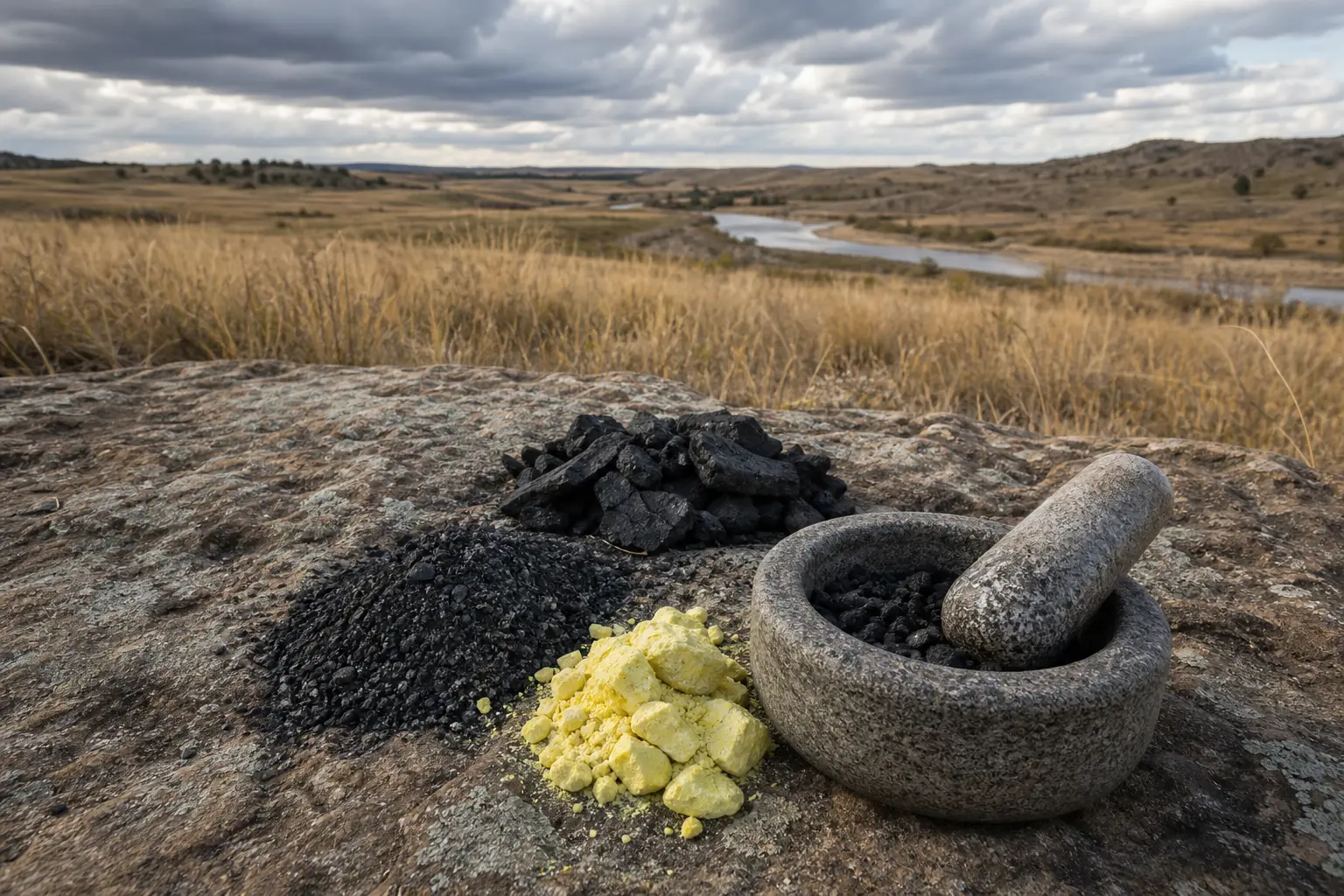
Black powder is the oldest true propellant, and its formula has been remarkably stable for centuries. The standard ratio used across the flintlock and percussion eras was three parts of charcoal and sulfur to fifteen of saltpeter, which works out to roughly 75 percent potassium nitrate, 15 percent charcoal, and 10 percent sulfur by weight. The saltpeter is the oxidizer, the charcoal is the fuel, and the sulfur lowers the ignition temperature and speeds the burn while also making the powder less sensitive to the damp that was the frontier shooter’s constant enemy.
Saltpeter, or potassium nitrate, was the single hardest ingredient to obtain on the American frontier precisely because it had to be produced rather than mined. It forms naturally through the bacterial breakdown of nitrogen rich organic matter, animal urine and manure chief among them, in dry, sheltered, alkaline soil. The classic source was earth scraped from under barns, corrals, caves, and long used livestock pens, which is why the white crust the articles describe was a real and well known sign to people who knew what to look for. The scraped earth was leached with water, the liquid filtered through ash, and the nitrate recovered by boiling and crystallization. It was so central to warfare that for centuries governments compelled farmers to dig their own cellar floors and stable beds for the stuff, and in the early American republic the production of saltpeter was a genuine patriotic duty.
Charcoal for powder was almost always made from fast, light woods like willow, alder, or dogwood, charred in covered kilns or pits rather than burned openly to ash, and sulfur came from volcanic or hot spring deposits or from imported brimstone, which is exactly why it was the rarest and most expensive of the three for someone far from a trading post. Genuine sulfur deposits in North America are comparatively scarce, and on the open plains a traveler would have counted every grain of it as carefully as the powder it completed.
Wetting and graining were real and essential steps, not flourishes. Ungrained “meal powder” burns so fast and unevenly that it can burst a barrel and throws erratically, so the damp cake was worked through screens or pressed and broken to a uniform grain that would burn at a controlled, predictable rate and pour cleanly through a measure. It also had to be kept scrupulously dry, because black powder is hygroscopic and a damp horn meant a rifle that would not fire at the single most important moment of a hunt. The Oregon and California trails saw roughly 400,000 people move west between 1841 and 1869, and for nearly all of them the rifle was both the source of meat and the currency of survival, which is why a frontiersman who could make his own powder out of scraped earth, charred willow, and a precious lump of sulfur carried a security no store bought charge could give him.
Sam crouches beside you and squints at your powder, and after a while he says the only useful thing anyone has said all day: the rifle still works, even near, even with a weak charge, and a weak charge at forty yards beats the loud stick at four hundred. You test it in the gray light before full dark, a small measure down the barrel and a snap of the lock, and the sound is not the flat crack you wanted, it is a softer, dirtier bark, but it throws fire and it throws a ball and the boy grins and Hannah lets out a breath she has been holding since morning. It will not be enough forever. It will be enough for now, and on the frontier, enough for now is a fortune most men never see.
What Was Real
Black powder is the oldest true propellant, and its formula has been remarkably stable for centuries. The standard ratio used across the flintlock and percussion eras was three parts of charcoal and sulfur to fifteen of saltpeter, which works out to roughly 75 percent potassium nitrate, 15 percent charcoal, and 10 percent sulfur by weight. The saltpeter is the oxidizer, the charcoal is the fuel, and the sulfur lowers the ignition temperature and speeds the burn while also making the powder less sensitive to the damp that was the frontier shooter’s constant enemy.
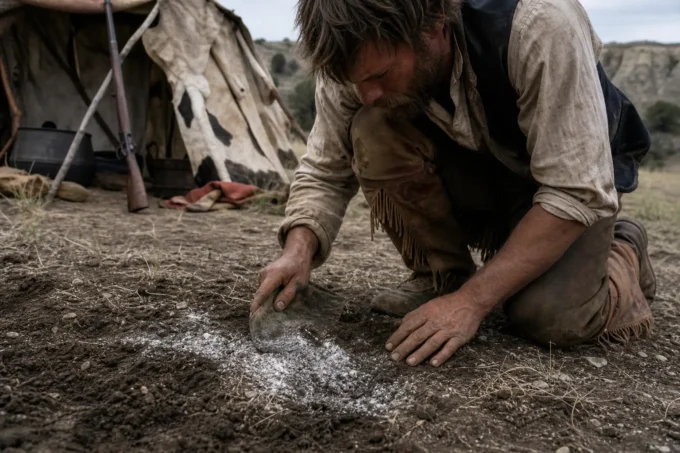
Saltpeter, or potassium nitrate, was the single hardest ingredient to obtain on the American frontier precisely because it had to be produced rather than mined. It forms naturally through the bacterial breakdown of nitrogen rich organic matter, animal urine and manure chief among them, in dry, sheltered, alkaline soil. The classic source was earth scraped from under barns, corrals, caves, and long used livestock pens, which is why the white crust the articles describe was a real and well known sign to people who knew what to look for. The scraped earth was leached with water, the liquid filtered through ash, and the nitrate recovered by boiling and crystallization. It was so central to warfare that for centuries governments compelled farmers to dig their own cellar floors and stable beds for the stuff, and in the early American republic the production of saltpeter was a genuine patriotic duty.
Charcoal for powder was almost always made from fast, light woods like willow, alder, or dogwood, charred in covered kilns or pits rather than burned openly to ash, and sulfur came from volcanic or hot spring deposits or from imported brimstone, which is exactly why it was the rarest and most expensive of the three for someone far from a trading post. Genuine sulfur deposits in North America are comparatively scarce, and on the open plains a traveler would have counted every grain of it as carefully as the powder it completed.
Wetting and graining were real and essential steps, not flourishes. Ungrained “meal powder” burns so fast and unevenly that it can burst a barrel and throws erratically, so the damp cake was worked through screens or pressed and broken to a uniform grain that would burn at a controlled, predictable rate and pour cleanly through a measure. It also had to be kept scrupulously dry, because black powder is hygroscopic and a damp horn meant a rifle that would not fire at the single most important moment of a hunt. The Oregon and California trails saw roughly 400,000 people move west between 1841 and 1869, and for nearly all of them the rifle was both the source of meat and the currency of survival, which is why a frontiersman who could make his own powder out of scraped earth, charred willow, and a precious lump of sulfur carried a security no store bought charge could give him.
Sam crouches beside you and squints at your powder, and after a while he says the only useful thing anyone has said all day: the rifle still works, even near, even with a weak charge, and a weak charge at forty yards beats the loud stick at four hundred. You test it in the gray light before full dark, a small measure down the barrel and a snap of the lock, and the sound is not the flat crack you wanted, it is a softer, dirtier bark, but it throws fire and it throws a ball and the boy grins and Hannah lets out a breath she has been holding since morning. It will not be enough forever. It will be enough for now, and on the frontier, enough for now is a fortune most men never see.
What Was Real
Black powder is the oldest true propellant, and its formula has been remarkably stable for centuries. The standard ratio used across the flintlock and percussion eras was three parts of charcoal and sulfur to fifteen of saltpeter, which works out to roughly 75 percent potassium nitrate, 15 percent charcoal, and 10 percent sulfur by weight. The saltpeter is the oxidizer, the charcoal is the fuel, and the sulfur lowers the ignition temperature and speeds the burn while also making the powder less sensitive to the damp that was the frontier shooter’s constant enemy.
Saltpeter, or potassium nitrate, was the single hardest ingredient to obtain on the American frontier precisely because it had to be produced rather than mined. It forms naturally through the bacterial breakdown of nitrogen rich organic matter, animal urine and manure chief among them, in dry, sheltered, alkaline soil. The classic source was earth scraped from under barns, corrals, caves, and long used livestock pens, which is why the white crust the articles describe was a real and well known sign to people who knew what to look for. The scraped earth was leached with water, the liquid filtered through ash, and the nitrate recovered by boiling and crystallization. It was so central to warfare that for centuries governments compelled farmers to dig their own cellar floors and stable beds for the stuff, and in the early American republic the production of saltpeter was a genuine patriotic duty.
Charcoal for powder was almost always made from fast, light woods like willow, alder, or dogwood, charred in covered kilns or pits rather than burned openly to ash, and sulfur came from volcanic or hot spring deposits or from imported brimstone, which is exactly why it was the rarest and most expensive of the three for someone far from a trading post. Genuine sulfur deposits in North America are comparatively scarce, and on the open plains a traveler would have counted every grain of it as carefully as the powder it completed.
Wetting and graining were real and essential steps, not flourishes. Ungrained “meal powder” burns so fast and unevenly that it can burst a barrel and throws erratically, so the damp cake was worked through screens or pressed and broken to a uniform grain that would burn at a controlled, predictable rate and pour cleanly through a measure. It also had to be kept scrupulously dry, because black powder is hygroscopic and a damp horn meant a rifle that would not fire at the single most important moment of a hunt. The Oregon and California trails saw roughly 400,000 people move west between 1841 and 1869, and for nearly all of them the rifle was both the source of meat and the currency of survival, which is why a frontiersman who could make his own powder out of scraped earth, charred willow, and a precious lump of sulfur carried a security no store bought charge could give him.
It happens at dusk, when the granules are nearly dry and you have just begun to believe this might actually work. You have been parceling Morrison’s little lump of sulfur with a miser’s hand, and the truth is you never had enough. Saltpeter and charcoal alone will burn, but they burn weak and dirty and they do not drive a ball the way a true charge must, and late in the evening you are left with a pile of grained black that is shy of its full measure and a lump of yellow the size of a child’s fingernail. You sit down hard on the wagon tongue and for a long time you just look at it. It is the kind of defeat the plains hand out quietly, without thunder, the kind that leaves you tired instead of broken.
Sam crouches beside you and squints at your powder, and after a while he says the only useful thing anyone has said all day: the rifle still works, even near, even with a weak charge, and a weak charge at forty yards beats the loud stick at four hundred. You test it in the gray light before full dark, a small measure down the barrel and a snap of the lock, and the sound is not the flat crack you wanted, it is a softer, dirtier bark, but it throws fire and it throws a ball and the boy grins and Hannah lets out a breath she has been holding since morning. It will not be enough forever. It will be enough for now, and on the frontier, enough for now is a fortune most men never see.
What Was Real
Black powder is the oldest true propellant, and its formula has been remarkably stable for centuries. The standard ratio used across the flintlock and percussion eras was three parts of charcoal and sulfur to fifteen of saltpeter, which works out to roughly 75 percent potassium nitrate, 15 percent charcoal, and 10 percent sulfur by weight. The saltpeter is the oxidizer, the charcoal is the fuel, and the sulfur lowers the ignition temperature and speeds the burn while also making the powder less sensitive to the damp that was the frontier shooter’s constant enemy.
Saltpeter, or potassium nitrate, was the single hardest ingredient to obtain on the American frontier precisely because it had to be produced rather than mined. It forms naturally through the bacterial breakdown of nitrogen rich organic matter, animal urine and manure chief among them, in dry, sheltered, alkaline soil. The classic source was earth scraped from under barns, corrals, caves, and long used livestock pens, which is why the white crust the articles describe was a real and well known sign to people who knew what to look for. The scraped earth was leached with water, the liquid filtered through ash, and the nitrate recovered by boiling and crystallization. It was so central to warfare that for centuries governments compelled farmers to dig their own cellar floors and stable beds for the stuff, and in the early American republic the production of saltpeter was a genuine patriotic duty.
Charcoal for powder was almost always made from fast, light woods like willow, alder, or dogwood, charred in covered kilns or pits rather than burned openly to ash, and sulfur came from volcanic or hot spring deposits or from imported brimstone, which is exactly why it was the rarest and most expensive of the three for someone far from a trading post. Genuine sulfur deposits in North America are comparatively scarce, and on the open plains a traveler would have counted every grain of it as carefully as the powder it completed.
Wetting and graining were real and essential steps, not flourishes. Ungrained “meal powder” burns so fast and unevenly that it can burst a barrel and throws erratically, so the damp cake was worked through screens or pressed and broken to a uniform grain that would burn at a controlled, predictable rate and pour cleanly through a measure. It also had to be kept scrupulously dry, because black powder is hygroscopic and a damp horn meant a rifle that would not fire at the single most important moment of a hunt. The Oregon and California trails saw roughly 400,000 people move west between 1841 and 1869, and for nearly all of them the rifle was both the source of meat and the currency of survival, which is why a frontiersman who could make his own powder out of scraped earth, charred willow, and a precious lump of sulfur carried a security no store bought charge could give him.
It happens at dusk, when the granules are nearly dry and you have just begun to believe this might actually work. You have been parceling Morrison’s little lump of sulfur with a miser’s hand, and the truth is you never had enough. Saltpeter and charcoal alone will burn, but they burn weak and dirty and they do not drive a ball the way a true charge must, and late in the evening you are left with a pile of grained black that is shy of its full measure and a lump of yellow the size of a child’s fingernail. You sit down hard on the wagon tongue and for a long time you just look at it. It is the kind of defeat the plains hand out quietly, without thunder, the kind that leaves you tired instead of broken.
Sam crouches beside you and squints at your powder, and after a while he says the only useful thing anyone has said all day: the rifle still works, even near, even with a weak charge, and a weak charge at forty yards beats the loud stick at four hundred. You test it in the gray light before full dark, a small measure down the barrel and a snap of the lock, and the sound is not the flat crack you wanted, it is a softer, dirtier bark, but it throws fire and it throws a ball and the boy grins and Hannah lets out a breath she has been holding since morning. It will not be enough forever. It will be enough for now, and on the frontier, enough for now is a fortune most men never see.
What Was Real
Black powder is the oldest true propellant, and its formula has been remarkably stable for centuries. The standard ratio used across the flintlock and percussion eras was three parts of charcoal and sulfur to fifteen of saltpeter, which works out to roughly 75 percent potassium nitrate, 15 percent charcoal, and 10 percent sulfur by weight. The saltpeter is the oxidizer, the charcoal is the fuel, and the sulfur lowers the ignition temperature and speeds the burn while also making the powder less sensitive to the damp that was the frontier shooter’s constant enemy.
Saltpeter, or potassium nitrate, was the single hardest ingredient to obtain on the American frontier precisely because it had to be produced rather than mined. It forms naturally through the bacterial breakdown of nitrogen rich organic matter, animal urine and manure chief among them, in dry, sheltered, alkaline soil. The classic source was earth scraped from under barns, corrals, caves, and long used livestock pens, which is why the white crust the articles describe was a real and well known sign to people who knew what to look for. The scraped earth was leached with water, the liquid filtered through ash, and the nitrate recovered by boiling and crystallization. It was so central to warfare that for centuries governments compelled farmers to dig their own cellar floors and stable beds for the stuff, and in the early American republic the production of saltpeter was a genuine patriotic duty.
Charcoal for powder was almost always made from fast, light woods like willow, alder, or dogwood, charred in covered kilns or pits rather than burned openly to ash, and sulfur came from volcanic or hot spring deposits or from imported brimstone, which is exactly why it was the rarest and most expensive of the three for someone far from a trading post. Genuine sulfur deposits in North America are comparatively scarce, and on the open plains a traveler would have counted every grain of it as carefully as the powder it completed.
Wetting and graining were real and essential steps, not flourishes. Ungrained “meal powder” burns so fast and unevenly that it can burst a barrel and throws erratically, so the damp cake was worked through screens or pressed and broken to a uniform grain that would burn at a controlled, predictable rate and pour cleanly through a measure. It also had to be kept scrupulously dry, because black powder is hygroscopic and a damp horn meant a rifle that would not fire at the single most important moment of a hunt. The Oregon and California trails saw roughly 400,000 people move west between 1841 and 1869, and for nearly all of them the rifle was both the source of meat and the currency of survival, which is why a frontiersman who could make his own powder out of scraped earth, charred willow, and a precious lump of sulfur carried a security no store bought charge could give him.
Hannah moves through the middle of all of it without once asking what you are doing. She fetches water, she banks the fire, she hands you a strip of cloth to strain the liquor, and then she goes back to sorting beans and says nothing at all. That silence is its own kind of help, and you are grateful for it, because you cannot afford to be interrupted and you cannot afford to be comforted. You think, once, about the man back east who reads about the frontier in a newspaper and imagines it as a place of clean certainties. He does not know there is a whole arithmetic of survival running under every mile, and that some part of it always comes down to whether you can scrape the white crust off a piece of old ground and turn it into the thing that feeds your family.
Then the sulfur runs out, and the powder is only three-quarters of a charge.
It happens at dusk, when the granules are nearly dry and you have just begun to believe this might actually work. You have been parceling Morrison’s little lump of sulfur with a miser’s hand, and the truth is you never had enough. Saltpeter and charcoal alone will burn, but they burn weak and dirty and they do not drive a ball the way a true charge must, and late in the evening you are left with a pile of grained black that is shy of its full measure and a lump of yellow the size of a child’s fingernail. You sit down hard on the wagon tongue and for a long time you just look at it. It is the kind of defeat the plains hand out quietly, without thunder, the kind that leaves you tired instead of broken.
Sam crouches beside you and squints at your powder, and after a while he says the only useful thing anyone has said all day: the rifle still works, even near, even with a weak charge, and a weak charge at forty yards beats the loud stick at four hundred. You test it in the gray light before full dark, a small measure down the barrel and a snap of the lock, and the sound is not the flat crack you wanted, it is a softer, dirtier bark, but it throws fire and it throws a ball and the boy grins and Hannah lets out a breath she has been holding since morning. It will not be enough forever. It will be enough for now, and on the frontier, enough for now is a fortune most men never see.
What Was Real
Black powder is the oldest true propellant, and its formula has been remarkably stable for centuries. The standard ratio used across the flintlock and percussion eras was three parts of charcoal and sulfur to fifteen of saltpeter, which works out to roughly 75 percent potassium nitrate, 15 percent charcoal, and 10 percent sulfur by weight. The saltpeter is the oxidizer, the charcoal is the fuel, and the sulfur lowers the ignition temperature and speeds the burn while also making the powder less sensitive to the damp that was the frontier shooter’s constant enemy.
Saltpeter, or potassium nitrate, was the single hardest ingredient to obtain on the American frontier precisely because it had to be produced rather than mined. It forms naturally through the bacterial breakdown of nitrogen rich organic matter, animal urine and manure chief among them, in dry, sheltered, alkaline soil. The classic source was earth scraped from under barns, corrals, caves, and long used livestock pens, which is why the white crust the articles describe was a real and well known sign to people who knew what to look for. The scraped earth was leached with water, the liquid filtered through ash, and the nitrate recovered by boiling and crystallization. It was so central to warfare that for centuries governments compelled farmers to dig their own cellar floors and stable beds for the stuff, and in the early American republic the production of saltpeter was a genuine patriotic duty.
Charcoal for powder was almost always made from fast, light woods like willow, alder, or dogwood, charred in covered kilns or pits rather than burned openly to ash, and sulfur came from volcanic or hot spring deposits or from imported brimstone, which is exactly why it was the rarest and most expensive of the three for someone far from a trading post. Genuine sulfur deposits in North America are comparatively scarce, and on the open plains a traveler would have counted every grain of it as carefully as the powder it completed.
Wetting and graining were real and essential steps, not flourishes. Ungrained “meal powder” burns so fast and unevenly that it can burst a barrel and throws erratically, so the damp cake was worked through screens or pressed and broken to a uniform grain that would burn at a controlled, predictable rate and pour cleanly through a measure. It also had to be kept scrupulously dry, because black powder is hygroscopic and a damp horn meant a rifle that would not fire at the single most important moment of a hunt. The Oregon and California trails saw roughly 400,000 people move west between 1841 and 1869, and for nearly all of them the rifle was both the source of meat and the currency of survival, which is why a frontiersman who could make his own powder out of scraped earth, charred willow, and a precious lump of sulfur carried a security no store bought charge could give him.
Raw dust is not powder yet. You add water, just enough to make a stiff cake, because the whole trick of real powder is to force the three ingredients into grains that burn at a controlled, even rate. Dust burns too fast, a hard whoosh that can split a barrel, and it does not pour or measure cleanly. So you work the damp cake against the flat stone until it crumbles into granules, and you dry those granules on a rack of willow over a low, careful fire, turning them with your fingers so they cure evenly and do not clump. The smell of saltpeter and charcoal and the faint, sharp yellow edge of sulfur hangs over the camp, and the boy keeps his distance now, because even at his age he has learned to respect the look on your face.
Hannah moves through the middle of all of it without once asking what you are doing. She fetches water, she banks the fire, she hands you a strip of cloth to strain the liquor, and then she goes back to sorting beans and says nothing at all. That silence is its own kind of help, and you are grateful for it, because you cannot afford to be interrupted and you cannot afford to be comforted. You think, once, about the man back east who reads about the frontier in a newspaper and imagines it as a place of clean certainties. He does not know there is a whole arithmetic of survival running under every mile, and that some part of it always comes down to whether you can scrape the white crust off a piece of old ground and turn it into the thing that feeds your family.
Then the sulfur runs out, and the powder is only three-quarters of a charge.
It happens at dusk, when the granules are nearly dry and you have just begun to believe this might actually work. You have been parceling Morrison’s little lump of sulfur with a miser’s hand, and the truth is you never had enough. Saltpeter and charcoal alone will burn, but they burn weak and dirty and they do not drive a ball the way a true charge must, and late in the evening you are left with a pile of grained black that is shy of its full measure and a lump of yellow the size of a child’s fingernail. You sit down hard on the wagon tongue and for a long time you just look at it. It is the kind of defeat the plains hand out quietly, without thunder, the kind that leaves you tired instead of broken.
Sam crouches beside you and squints at your powder, and after a while he says the only useful thing anyone has said all day: the rifle still works, even near, even with a weak charge, and a weak charge at forty yards beats the loud stick at four hundred. You test it in the gray light before full dark, a small measure down the barrel and a snap of the lock, and the sound is not the flat crack you wanted, it is a softer, dirtier bark, but it throws fire and it throws a ball and the boy grins and Hannah lets out a breath she has been holding since morning. It will not be enough forever. It will be enough for now, and on the frontier, enough for now is a fortune most men never see.
What Was Real
Black powder is the oldest true propellant, and its formula has been remarkably stable for centuries. The standard ratio used across the flintlock and percussion eras was three parts of charcoal and sulfur to fifteen of saltpeter, which works out to roughly 75 percent potassium nitrate, 15 percent charcoal, and 10 percent sulfur by weight. The saltpeter is the oxidizer, the charcoal is the fuel, and the sulfur lowers the ignition temperature and speeds the burn while also making the powder less sensitive to the damp that was the frontier shooter’s constant enemy.
Saltpeter, or potassium nitrate, was the single hardest ingredient to obtain on the American frontier precisely because it had to be produced rather than mined. It forms naturally through the bacterial breakdown of nitrogen rich organic matter, animal urine and manure chief among them, in dry, sheltered, alkaline soil. The classic source was earth scraped from under barns, corrals, caves, and long used livestock pens, which is why the white crust the articles describe was a real and well known sign to people who knew what to look for. The scraped earth was leached with water, the liquid filtered through ash, and the nitrate recovered by boiling and crystallization. It was so central to warfare that for centuries governments compelled farmers to dig their own cellar floors and stable beds for the stuff, and in the early American republic the production of saltpeter was a genuine patriotic duty.
Charcoal for powder was almost always made from fast, light woods like willow, alder, or dogwood, charred in covered kilns or pits rather than burned openly to ash, and sulfur came from volcanic or hot spring deposits or from imported brimstone, which is exactly why it was the rarest and most expensive of the three for someone far from a trading post. Genuine sulfur deposits in North America are comparatively scarce, and on the open plains a traveler would have counted every grain of it as carefully as the powder it completed.
Wetting and graining were real and essential steps, not flourishes. Ungrained “meal powder” burns so fast and unevenly that it can burst a barrel and throws erratically, so the damp cake was worked through screens or pressed and broken to a uniform grain that would burn at a controlled, predictable rate and pour cleanly through a measure. It also had to be kept scrupulously dry, because black powder is hygroscopic and a damp horn meant a rifle that would not fire at the single most important moment of a hunt. The Oregon and California trails saw roughly 400,000 people move west between 1841 and 1869, and for nearly all of them the rifle was both the source of meat and the currency of survival, which is why a frontiersman who could make his own powder out of scraped earth, charred willow, and a precious lump of sulfur carried a security no store bought charge could give him.
Then comes the part that cannot be rushed and cannot be skimped. You grind, and you grind, and you grind. The saltpeter crystals have to become as fine as the flour Hannah hoards, the charcoal has to become dust, and they have to be blended so perfectly that no single pinch is richer than any other. A bad charge with a fat spot of sulfur or a lean spot of saltpeter will throw a ball wild or, worse, fizzle in the pan while a deer watches you curse. You use the flat of a knife and a rounded stone, and your shoulders burn, and every few minutes you stop and rub the mixture between your fingers the way Hannah tests cornmeal for lumps. Sam watches and says nothing. That is how he approves.
Wetting, graining, and the one mistake that would end everything.
Raw dust is not powder yet. You add water, just enough to make a stiff cake, because the whole trick of real powder is to force the three ingredients into grains that burn at a controlled, even rate. Dust burns too fast, a hard whoosh that can split a barrel, and it does not pour or measure cleanly. So you work the damp cake against the flat stone until it crumbles into granules, and you dry those granules on a rack of willow over a low, careful fire, turning them with your fingers so they cure evenly and do not clump. The smell of saltpeter and charcoal and the faint, sharp yellow edge of sulfur hangs over the camp, and the boy keeps his distance now, because even at his age he has learned to respect the look on your face.
Hannah moves through the middle of all of it without once asking what you are doing. She fetches water, she banks the fire, she hands you a strip of cloth to strain the liquor, and then she goes back to sorting beans and says nothing at all. That silence is its own kind of help, and you are grateful for it, because you cannot afford to be interrupted and you cannot afford to be comforted. You think, once, about the man back east who reads about the frontier in a newspaper and imagines it as a place of clean certainties. He does not know there is a whole arithmetic of survival running under every mile, and that some part of it always comes down to whether you can scrape the white crust off a piece of old ground and turn it into the thing that feeds your family.
Then the sulfur runs out, and the powder is only three-quarters of a charge.
It happens at dusk, when the granules are nearly dry and you have just begun to believe this might actually work. You have been parceling Morrison’s little lump of sulfur with a miser’s hand, and the truth is you never had enough. Saltpeter and charcoal alone will burn, but they burn weak and dirty and they do not drive a ball the way a true charge must, and late in the evening you are left with a pile of grained black that is shy of its full measure and a lump of yellow the size of a child’s fingernail. You sit down hard on the wagon tongue and for a long time you just look at it. It is the kind of defeat the plains hand out quietly, without thunder, the kind that leaves you tired instead of broken.
Sam crouches beside you and squints at your powder, and after a while he says the only useful thing anyone has said all day: the rifle still works, even near, even with a weak charge, and a weak charge at forty yards beats the loud stick at four hundred. You test it in the gray light before full dark, a small measure down the barrel and a snap of the lock, and the sound is not the flat crack you wanted, it is a softer, dirtier bark, but it throws fire and it throws a ball and the boy grins and Hannah lets out a breath she has been holding since morning. It will not be enough forever. It will be enough for now, and on the frontier, enough for now is a fortune most men never see.
What Was Real
Black powder is the oldest true propellant, and its formula has been remarkably stable for centuries. The standard ratio used across the flintlock and percussion eras was three parts of charcoal and sulfur to fifteen of saltpeter, which works out to roughly 75 percent potassium nitrate, 15 percent charcoal, and 10 percent sulfur by weight. The saltpeter is the oxidizer, the charcoal is the fuel, and the sulfur lowers the ignition temperature and speeds the burn while also making the powder less sensitive to the damp that was the frontier shooter’s constant enemy.
Saltpeter, or potassium nitrate, was the single hardest ingredient to obtain on the American frontier precisely because it had to be produced rather than mined. It forms naturally through the bacterial breakdown of nitrogen rich organic matter, animal urine and manure chief among them, in dry, sheltered, alkaline soil. The classic source was earth scraped from under barns, corrals, caves, and long used livestock pens, which is why the white crust the articles describe was a real and well known sign to people who knew what to look for. The scraped earth was leached with water, the liquid filtered through ash, and the nitrate recovered by boiling and crystallization. It was so central to warfare that for centuries governments compelled farmers to dig their own cellar floors and stable beds for the stuff, and in the early American republic the production of saltpeter was a genuine patriotic duty.
Charcoal for powder was almost always made from fast, light woods like willow, alder, or dogwood, charred in covered kilns or pits rather than burned openly to ash, and sulfur came from volcanic or hot spring deposits or from imported brimstone, which is exactly why it was the rarest and most expensive of the three for someone far from a trading post. Genuine sulfur deposits in North America are comparatively scarce, and on the open plains a traveler would have counted every grain of it as carefully as the powder it completed.
Wetting and graining were real and essential steps, not flourishes. Ungrained “meal powder” burns so fast and unevenly that it can burst a barrel and throws erratically, so the damp cake was worked through screens or pressed and broken to a uniform grain that would burn at a controlled, predictable rate and pour cleanly through a measure. It also had to be kept scrupulously dry, because black powder is hygroscopic and a damp horn meant a rifle that would not fire at the single most important moment of a hunt. The Oregon and California trails saw roughly 400,000 people move west between 1841 and 1869, and for nearly all of them the rifle was both the source of meat and the currency of survival, which is why a frontiersman who could make his own powder out of scraped earth, charred willow, and a precious lump of sulfur carried a security no store bought charge could give him.
You send Sam and the boy down to the willow thicket by the river with the hand axe and a canvas sack, and you tell them to cut thin green withes, nothing thicker than a thumb, because willow makes the fastest, lightest charcoal and powder wants the kind of carbon that burns quick and clean. You do not burn the wood open to the sky, you char it, which means you bank it in a covered pit and let it smolder without enough air to turn to ash. The smoke comes up thin and blue and smells of river water and green bark. When you pull the sticks out they are black and light and rattle against each other like dead reeds, and the boy wants to know if you can eat them, and you tell him no, but you can kill a deer with them, which he finds much more interesting.
Then comes the part that cannot be rushed and cannot be skimped. You grind, and you grind, and you grind. The saltpeter crystals have to become as fine as the flour Hannah hoards, the charcoal has to become dust, and they have to be blended so perfectly that no single pinch is richer than any other. A bad charge with a fat spot of sulfur or a lean spot of saltpeter will throw a ball wild or, worse, fizzle in the pan while a deer watches you curse. You use the flat of a knife and a rounded stone, and your shoulders burn, and every few minutes you stop and rub the mixture between your fingers the way Hannah tests cornmeal for lumps. Sam watches and says nothing. That is how he approves.
Wetting, graining, and the one mistake that would end everything.
Raw dust is not powder yet. You add water, just enough to make a stiff cake, because the whole trick of real powder is to force the three ingredients into grains that burn at a controlled, even rate. Dust burns too fast, a hard whoosh that can split a barrel, and it does not pour or measure cleanly. So you work the damp cake against the flat stone until it crumbles into granules, and you dry those granules on a rack of willow over a low, careful fire, turning them with your fingers so they cure evenly and do not clump. The smell of saltpeter and charcoal and the faint, sharp yellow edge of sulfur hangs over the camp, and the boy keeps his distance now, because even at his age he has learned to respect the look on your face.
Hannah moves through the middle of all of it without once asking what you are doing. She fetches water, she banks the fire, she hands you a strip of cloth to strain the liquor, and then she goes back to sorting beans and says nothing at all. That silence is its own kind of help, and you are grateful for it, because you cannot afford to be interrupted and you cannot afford to be comforted. You think, once, about the man back east who reads about the frontier in a newspaper and imagines it as a place of clean certainties. He does not know there is a whole arithmetic of survival running under every mile, and that some part of it always comes down to whether you can scrape the white crust off a piece of old ground and turn it into the thing that feeds your family.
Then the sulfur runs out, and the powder is only three-quarters of a charge.
It happens at dusk, when the granules are nearly dry and you have just begun to believe this might actually work. You have been parceling Morrison’s little lump of sulfur with a miser’s hand, and the truth is you never had enough. Saltpeter and charcoal alone will burn, but they burn weak and dirty and they do not drive a ball the way a true charge must, and late in the evening you are left with a pile of grained black that is shy of its full measure and a lump of yellow the size of a child’s fingernail. You sit down hard on the wagon tongue and for a long time you just look at it. It is the kind of defeat the plains hand out quietly, without thunder, the kind that leaves you tired instead of broken.
Sam crouches beside you and squints at your powder, and after a while he says the only useful thing anyone has said all day: the rifle still works, even near, even with a weak charge, and a weak charge at forty yards beats the loud stick at four hundred. You test it in the gray light before full dark, a small measure down the barrel and a snap of the lock, and the sound is not the flat crack you wanted, it is a softer, dirtier bark, but it throws fire and it throws a ball and the boy grins and Hannah lets out a breath she has been holding since morning. It will not be enough forever. It will be enough for now, and on the frontier, enough for now is a fortune most men never see.
What Was Real
Black powder is the oldest true propellant, and its formula has been remarkably stable for centuries. The standard ratio used across the flintlock and percussion eras was three parts of charcoal and sulfur to fifteen of saltpeter, which works out to roughly 75 percent potassium nitrate, 15 percent charcoal, and 10 percent sulfur by weight. The saltpeter is the oxidizer, the charcoal is the fuel, and the sulfur lowers the ignition temperature and speeds the burn while also making the powder less sensitive to the damp that was the frontier shooter’s constant enemy.
Saltpeter, or potassium nitrate, was the single hardest ingredient to obtain on the American frontier precisely because it had to be produced rather than mined. It forms naturally through the bacterial breakdown of nitrogen rich organic matter, animal urine and manure chief among them, in dry, sheltered, alkaline soil. The classic source was earth scraped from under barns, corrals, caves, and long used livestock pens, which is why the white crust the articles describe was a real and well known sign to people who knew what to look for. The scraped earth was leached with water, the liquid filtered through ash, and the nitrate recovered by boiling and crystallization. It was so central to warfare that for centuries governments compelled farmers to dig their own cellar floors and stable beds for the stuff, and in the early American republic the production of saltpeter was a genuine patriotic duty.
Charcoal for powder was almost always made from fast, light woods like willow, alder, or dogwood, charred in covered kilns or pits rather than burned openly to ash, and sulfur came from volcanic or hot spring deposits or from imported brimstone, which is exactly why it was the rarest and most expensive of the three for someone far from a trading post. Genuine sulfur deposits in North America are comparatively scarce, and on the open plains a traveler would have counted every grain of it as carefully as the powder it completed.
Wetting and graining were real and essential steps, not flourishes. Ungrained “meal powder” burns so fast and unevenly that it can burst a barrel and throws erratically, so the damp cake was worked through screens or pressed and broken to a uniform grain that would burn at a controlled, predictable rate and pour cleanly through a measure. It also had to be kept scrupulously dry, because black powder is hygroscopic and a damp horn meant a rifle that would not fire at the single most important moment of a hunt. The Oregon and California trails saw roughly 400,000 people move west between 1841 and 1869, and for nearly all of them the rifle was both the source of meat and the currency of survival, which is why a frontiersman who could make his own powder out of scraped earth, charred willow, and a precious lump of sulfur carried a security no store bought charge could give him.
So you start with what you can get, and you start with saltpeter, because without saltpeter nothing else matters. Saltpeter forms where animal waste and old soil and urine have soaked into the ground and dried, over and over, season after season, until a white crust blooms on the surface like a thin frost in July. You look for it under old shade trees where stock was tied for years, in the dirt floors of abandoned shelters, on the dry lee side of anything with a roof of bone or hide. You scrape the top soil where the white shows, and you boil it, and you strain it, and you let the crystals come back out of the water as it cools. It is a slow, ugly, patience job, and it smells the way a latrine smells on a hot afternoon, and your hands crack from the alkali in the earth. You do it anyway, because the alternative is the loud stick.
The charcoal you make while the scraped earth boils.
You send Sam and the boy down to the willow thicket by the river with the hand axe and a canvas sack, and you tell them to cut thin green withes, nothing thicker than a thumb, because willow makes the fastest, lightest charcoal and powder wants the kind of carbon that burns quick and clean. You do not burn the wood open to the sky, you char it, which means you bank it in a covered pit and let it smolder without enough air to turn to ash. The smoke comes up thin and blue and smells of river water and green bark. When you pull the sticks out they are black and light and rattle against each other like dead reeds, and the boy wants to know if you can eat them, and you tell him no, but you can kill a deer with them, which he finds much more interesting.
Then comes the part that cannot be rushed and cannot be skimped. You grind, and you grind, and you grind. The saltpeter crystals have to become as fine as the flour Hannah hoards, the charcoal has to become dust, and they have to be blended so perfectly that no single pinch is richer than any other. A bad charge with a fat spot of sulfur or a lean spot of saltpeter will throw a ball wild or, worse, fizzle in the pan while a deer watches you curse. You use the flat of a knife and a rounded stone, and your shoulders burn, and every few minutes you stop and rub the mixture between your fingers the way Hannah tests cornmeal for lumps. Sam watches and says nothing. That is how he approves.
Wetting, graining, and the one mistake that would end everything.
Raw dust is not powder yet. You add water, just enough to make a stiff cake, because the whole trick of real powder is to force the three ingredients into grains that burn at a controlled, even rate. Dust burns too fast, a hard whoosh that can split a barrel, and it does not pour or measure cleanly. So you work the damp cake against the flat stone until it crumbles into granules, and you dry those granules on a rack of willow over a low, careful fire, turning them with your fingers so they cure evenly and do not clump. The smell of saltpeter and charcoal and the faint, sharp yellow edge of sulfur hangs over the camp, and the boy keeps his distance now, because even at his age he has learned to respect the look on your face.
Hannah moves through the middle of all of it without once asking what you are doing. She fetches water, she banks the fire, she hands you a strip of cloth to strain the liquor, and then she goes back to sorting beans and says nothing at all. That silence is its own kind of help, and you are grateful for it, because you cannot afford to be interrupted and you cannot afford to be comforted. You think, once, about the man back east who reads about the frontier in a newspaper and imagines it as a place of clean certainties. He does not know there is a whole arithmetic of survival running under every mile, and that some part of it always comes down to whether you can scrape the white crust off a piece of old ground and turn it into the thing that feeds your family.
Then the sulfur runs out, and the powder is only three-quarters of a charge.
It happens at dusk, when the granules are nearly dry and you have just begun to believe this might actually work. You have been parceling Morrison’s little lump of sulfur with a miser’s hand, and the truth is you never had enough. Saltpeter and charcoal alone will burn, but they burn weak and dirty and they do not drive a ball the way a true charge must, and late in the evening you are left with a pile of grained black that is shy of its full measure and a lump of yellow the size of a child’s fingernail. You sit down hard on the wagon tongue and for a long time you just look at it. It is the kind of defeat the plains hand out quietly, without thunder, the kind that leaves you tired instead of broken.
Sam crouches beside you and squints at your powder, and after a while he says the only useful thing anyone has said all day: the rifle still works, even near, even with a weak charge, and a weak charge at forty yards beats the loud stick at four hundred. You test it in the gray light before full dark, a small measure down the barrel and a snap of the lock, and the sound is not the flat crack you wanted, it is a softer, dirtier bark, but it throws fire and it throws a ball and the boy grins and Hannah lets out a breath she has been holding since morning. It will not be enough forever. It will be enough for now, and on the frontier, enough for now is a fortune most men never see.
What Was Real
Black powder is the oldest true propellant, and its formula has been remarkably stable for centuries. The standard ratio used across the flintlock and percussion eras was three parts of charcoal and sulfur to fifteen of saltpeter, which works out to roughly 75 percent potassium nitrate, 15 percent charcoal, and 10 percent sulfur by weight. The saltpeter is the oxidizer, the charcoal is the fuel, and the sulfur lowers the ignition temperature and speeds the burn while also making the powder less sensitive to the damp that was the frontier shooter’s constant enemy.
Saltpeter, or potassium nitrate, was the single hardest ingredient to obtain on the American frontier precisely because it had to be produced rather than mined. It forms naturally through the bacterial breakdown of nitrogen rich organic matter, animal urine and manure chief among them, in dry, sheltered, alkaline soil. The classic source was earth scraped from under barns, corrals, caves, and long used livestock pens, which is why the white crust the articles describe was a real and well known sign to people who knew what to look for. The scraped earth was leached with water, the liquid filtered through ash, and the nitrate recovered by boiling and crystallization. It was so central to warfare that for centuries governments compelled farmers to dig their own cellar floors and stable beds for the stuff, and in the early American republic the production of saltpeter was a genuine patriotic duty.
Charcoal for powder was almost always made from fast, light woods like willow, alder, or dogwood, charred in covered kilns or pits rather than burned openly to ash, and sulfur came from volcanic or hot spring deposits or from imported brimstone, which is exactly why it was the rarest and most expensive of the three for someone far from a trading post. Genuine sulfur deposits in North America are comparatively scarce, and on the open plains a traveler would have counted every grain of it as carefully as the powder it completed.
Wetting and graining were real and essential steps, not flourishes. Ungrained “meal powder” burns so fast and unevenly that it can burst a barrel and throws erratically, so the damp cake was worked through screens or pressed and broken to a uniform grain that would burn at a controlled, predictable rate and pour cleanly through a measure. It also had to be kept scrupulously dry, because black powder is hygroscopic and a damp horn meant a rifle that would not fire at the single most important moment of a hunt. The Oregon and California trails saw roughly 400,000 people move west between 1841 and 1869, and for nearly all of them the rifle was both the source of meat and the currency of survival, which is why a frontiersman who could make his own powder out of scraped earth, charred willow, and a precious lump of sulfur carried a security no store bought charge could give him.
The old formula sits in your head the way a recipe sits in a cook’s head. Three parts, measured by weight: seventy-five parts saltpeter, fifteen parts charcoal, ten parts sulfur. That is the whole secret, the thing behind every cannon and every charge in the world, and it is not secret at all, it is just work. Saltpeter is the hardest of the three, the one that comes from dirt and patience and things nobody wants to touch. Charcoal is easy, you can burn willow or cottonwood all day. Sulfur is the trouble, because sulfur does not grow out of the plains and it does not come out of a buffalo. It comes from deposits far away, and when Morrison died he left you with only a thumb sized lump of yellow the color of a bruise gone bad.
So you start with what you can get, and you start with saltpeter, because without saltpeter nothing else matters. Saltpeter forms where animal waste and old soil and urine have soaked into the ground and dried, over and over, season after season, until a white crust blooms on the surface like a thin frost in July. You look for it under old shade trees where stock was tied for years, in the dirt floors of abandoned shelters, on the dry lee side of anything with a roof of bone or hide. You scrape the top soil where the white shows, and you boil it, and you strain it, and you let the crystals come back out of the water as it cools. It is a slow, ugly, patience job, and it smells the way a latrine smells on a hot afternoon, and your hands crack from the alkali in the earth. You do it anyway, because the alternative is the loud stick.
The charcoal you make while the scraped earth boils.
You send Sam and the boy down to the willow thicket by the river with the hand axe and a canvas sack, and you tell them to cut thin green withes, nothing thicker than a thumb, because willow makes the fastest, lightest charcoal and powder wants the kind of carbon that burns quick and clean. You do not burn the wood open to the sky, you char it, which means you bank it in a covered pit and let it smolder without enough air to turn to ash. The smoke comes up thin and blue and smells of river water and green bark. When you pull the sticks out they are black and light and rattle against each other like dead reeds, and the boy wants to know if you can eat them, and you tell him no, but you can kill a deer with them, which he finds much more interesting.
Then comes the part that cannot be rushed and cannot be skimped. You grind, and you grind, and you grind. The saltpeter crystals have to become as fine as the flour Hannah hoards, the charcoal has to become dust, and they have to be blended so perfectly that no single pinch is richer than any other. A bad charge with a fat spot of sulfur or a lean spot of saltpeter will throw a ball wild or, worse, fizzle in the pan while a deer watches you curse. You use the flat of a knife and a rounded stone, and your shoulders burn, and every few minutes you stop and rub the mixture between your fingers the way Hannah tests cornmeal for lumps. Sam watches and says nothing. That is how he approves.
Wetting, graining, and the one mistake that would end everything.
Raw dust is not powder yet. You add water, just enough to make a stiff cake, because the whole trick of real powder is to force the three ingredients into grains that burn at a controlled, even rate. Dust burns too fast, a hard whoosh that can split a barrel, and it does not pour or measure cleanly. So you work the damp cake against the flat stone until it crumbles into granules, and you dry those granules on a rack of willow over a low, careful fire, turning them with your fingers so they cure evenly and do not clump. The smell of saltpeter and charcoal and the faint, sharp yellow edge of sulfur hangs over the camp, and the boy keeps his distance now, because even at his age he has learned to respect the look on your face.
Hannah moves through the middle of all of it without once asking what you are doing. She fetches water, she banks the fire, she hands you a strip of cloth to strain the liquor, and then she goes back to sorting beans and says nothing at all. That silence is its own kind of help, and you are grateful for it, because you cannot afford to be interrupted and you cannot afford to be comforted. You think, once, about the man back east who reads about the frontier in a newspaper and imagines it as a place of clean certainties. He does not know there is a whole arithmetic of survival running under every mile, and that some part of it always comes down to whether you can scrape the white crust off a piece of old ground and turn it into the thing that feeds your family.
Then the sulfur runs out, and the powder is only three-quarters of a charge.
It happens at dusk, when the granules are nearly dry and you have just begun to believe this might actually work. You have been parceling Morrison’s little lump of sulfur with a miser’s hand, and the truth is you never had enough. Saltpeter and charcoal alone will burn, but they burn weak and dirty and they do not drive a ball the way a true charge must, and late in the evening you are left with a pile of grained black that is shy of its full measure and a lump of yellow the size of a child’s fingernail. You sit down hard on the wagon tongue and for a long time you just look at it. It is the kind of defeat the plains hand out quietly, without thunder, the kind that leaves you tired instead of broken.
Sam crouches beside you and squints at your powder, and after a while he says the only useful thing anyone has said all day: the rifle still works, even near, even with a weak charge, and a weak charge at forty yards beats the loud stick at four hundred. You test it in the gray light before full dark, a small measure down the barrel and a snap of the lock, and the sound is not the flat crack you wanted, it is a softer, dirtier bark, but it throws fire and it throws a ball and the boy grins and Hannah lets out a breath she has been holding since morning. It will not be enough forever. It will be enough for now, and on the frontier, enough for now is a fortune most men never see.
What Was Real
Black powder is the oldest true propellant, and its formula has been remarkably stable for centuries. The standard ratio used across the flintlock and percussion eras was three parts of charcoal and sulfur to fifteen of saltpeter, which works out to roughly 75 percent potassium nitrate, 15 percent charcoal, and 10 percent sulfur by weight. The saltpeter is the oxidizer, the charcoal is the fuel, and the sulfur lowers the ignition temperature and speeds the burn while also making the powder less sensitive to the damp that was the frontier shooter’s constant enemy.
Saltpeter, or potassium nitrate, was the single hardest ingredient to obtain on the American frontier precisely because it had to be produced rather than mined. It forms naturally through the bacterial breakdown of nitrogen rich organic matter, animal urine and manure chief among them, in dry, sheltered, alkaline soil. The classic source was earth scraped from under barns, corrals, caves, and long used livestock pens, which is why the white crust the articles describe was a real and well known sign to people who knew what to look for. The scraped earth was leached with water, the liquid filtered through ash, and the nitrate recovered by boiling and crystallization. It was so central to warfare that for centuries governments compelled farmers to dig their own cellar floors and stable beds for the stuff, and in the early American republic the production of saltpeter was a genuine patriotic duty.
Charcoal for powder was almost always made from fast, light woods like willow, alder, or dogwood, charred in covered kilns or pits rather than burned openly to ash, and sulfur came from volcanic or hot spring deposits or from imported brimstone, which is exactly why it was the rarest and most expensive of the three for someone far from a trading post. Genuine sulfur deposits in North America are comparatively scarce, and on the open plains a traveler would have counted every grain of it as carefully as the powder it completed.
Wetting and graining were real and essential steps, not flourishes. Ungrained “meal powder” burns so fast and unevenly that it can burst a barrel and throws erratically, so the damp cake was worked through screens or pressed and broken to a uniform grain that would burn at a controlled, predictable rate and pour cleanly through a measure. It also had to be kept scrupulously dry, because black powder is hygroscopic and a damp horn meant a rifle that would not fire at the single most important moment of a hunt. The Oregon and California trails saw roughly 400,000 people move west between 1841 and 1869, and for nearly all of them the rifle was both the source of meat and the currency of survival, which is why a frontiersman who could make his own powder out of scraped earth, charred willow, and a precious lump of sulfur carried a security no store bought charge could give him.
You wake because the powder horn is lighter than it was yesterday.
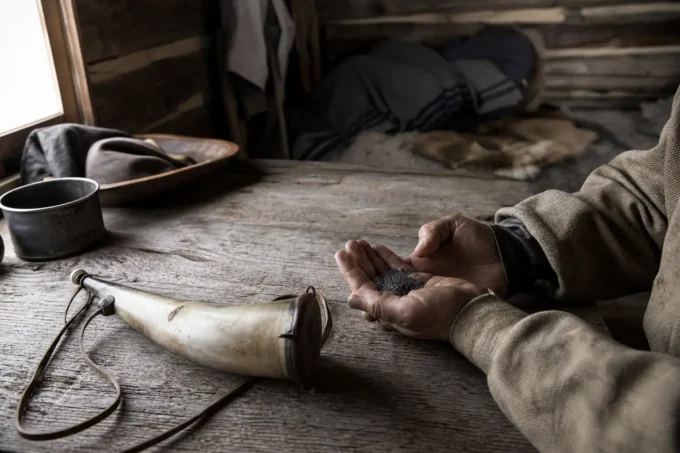
Late September, 1846. Somewhere east of Fort Laramie, where the Platte runs shallow and the buffalo grass already smells like cured hay. You reach for the horn that hangs under your coat, the one that rides against your ribs all day so your body heat keeps the grains dry. It swings too easy. You tip it and pour a measure into your palm, and what falls out is the last honest charge you own. One pound of powder left, maybe less. Two hundred miles of open country still ahead, and the price of a fresh pound at Fort Laramie is three dollars now, when they have any to sell at all.
Sam sits up on his bedroll across the dead fire, and he does not have to ask. He has been counting your charges the way a man counts coins. Morrison is three weeks in the ground now, the flux took him, and before he died he told you the one thing that has been rattling around your head ever since: a man who uses a rifle on the frontier but cannot make what feeds it is a man who carries a very loud stick. You used to think he was just a bitter old trader. Now the horn is nearly empty and the sentence has stopped being advice and started being arithmetic.
The problem is simpler and worse than running out of lead.
Lead you can melt and recast. Lead comes out of the ground soft and forgiving, and a spent ball pulled from a tree or a riverbank can be run through the fire and made whole again. Powder gives you no second life. Powder is a finished thing, a factory thing, and out here there is no factory, no wagon carrying it, and no man near enough to buy from even if he had any black grains to spare. When the horn is empty the rifle stops being a rifle and becomes thirty pounds of iron you carry for no reason at all. That thought sits cold behind the ribs.
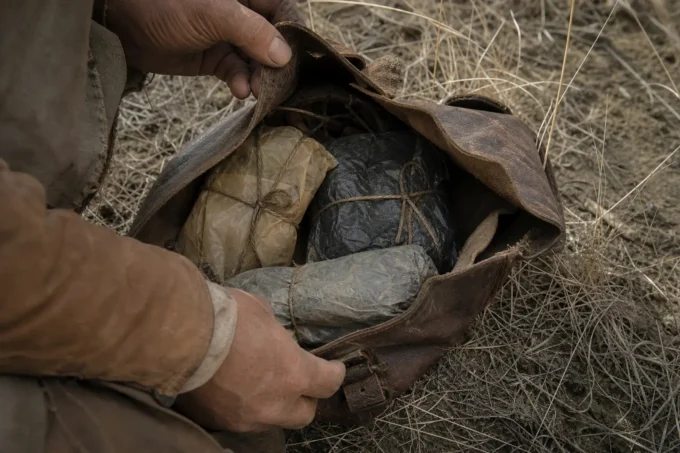
You think, briefly, about people back east who walk into a dry goods store and buy powder off a shelf like it was flour. They have never watched the last measure slide down a barrel and known the next ten meals depend on whether a deer walks into range before the horn stays empty. The thought does not help, and you push it away, because the only thing that helps is what Morrison actually left behind in that leather satchel of his, the one Hannah has been carrying without complaint for a month. You open it now, and inside, wrapped in oilcloth, you find the three things a man needs to make powder where there is no store on earth.
Black powder is three ingredients, and two of them you do not have.
The old formula sits in your head the way a recipe sits in a cook’s head. Three parts, measured by weight: seventy-five parts saltpeter, fifteen parts charcoal, ten parts sulfur. That is the whole secret, the thing behind every cannon and every charge in the world, and it is not secret at all, it is just work. Saltpeter is the hardest of the three, the one that comes from dirt and patience and things nobody wants to touch. Charcoal is easy, you can burn willow or cottonwood all day. Sulfur is the trouble, because sulfur does not grow out of the plains and it does not come out of a buffalo. It comes from deposits far away, and when Morrison died he left you with only a thumb sized lump of yellow the color of a bruise gone bad.
So you start with what you can get, and you start with saltpeter, because without saltpeter nothing else matters. Saltpeter forms where animal waste and old soil and urine have soaked into the ground and dried, over and over, season after season, until a white crust blooms on the surface like a thin frost in July. You look for it under old shade trees where stock was tied for years, in the dirt floors of abandoned shelters, on the dry lee side of anything with a roof of bone or hide. You scrape the top soil where the white shows, and you boil it, and you strain it, and you let the crystals come back out of the water as it cools. It is a slow, ugly, patience job, and it smells the way a latrine smells on a hot afternoon, and your hands crack from the alkali in the earth. You do it anyway, because the alternative is the loud stick.
The charcoal you make while the scraped earth boils.
You send Sam and the boy down to the willow thicket by the river with the hand axe and a canvas sack, and you tell them to cut thin green withes, nothing thicker than a thumb, because willow makes the fastest, lightest charcoal and powder wants the kind of carbon that burns quick and clean. You do not burn the wood open to the sky, you char it, which means you bank it in a covered pit and let it smolder without enough air to turn to ash. The smoke comes up thin and blue and smells of river water and green bark. When you pull the sticks out they are black and light and rattle against each other like dead reeds, and the boy wants to know if you can eat them, and you tell him no, but you can kill a deer with them, which he finds much more interesting.
Then comes the part that cannot be rushed and cannot be skimped. You grind, and you grind, and you grind. The saltpeter crystals have to become as fine as the flour Hannah hoards, the charcoal has to become dust, and they have to be blended so perfectly that no single pinch is richer than any other. A bad charge with a fat spot of sulfur or a lean spot of saltpeter will throw a ball wild or, worse, fizzle in the pan while a deer watches you curse. You use the flat of a knife and a rounded stone, and your shoulders burn, and every few minutes you stop and rub the mixture between your fingers the way Hannah tests cornmeal for lumps. Sam watches and says nothing. That is how he approves.
Wetting, graining, and the one mistake that would end everything.
Raw dust is not powder yet. You add water, just enough to make a stiff cake, because the whole trick of real powder is to force the three ingredients into grains that burn at a controlled, even rate. Dust burns too fast, a hard whoosh that can split a barrel, and it does not pour or measure cleanly. So you work the damp cake against the flat stone until it crumbles into granules, and you dry those granules on a rack of willow over a low, careful fire, turning them with your fingers so they cure evenly and do not clump. The smell of saltpeter and charcoal and the faint, sharp yellow edge of sulfur hangs over the camp, and the boy keeps his distance now, because even at his age he has learned to respect the look on your face.
Hannah moves through the middle of all of it without once asking what you are doing. She fetches water, she banks the fire, she hands you a strip of cloth to strain the liquor, and then she goes back to sorting beans and says nothing at all. That silence is its own kind of help, and you are grateful for it, because you cannot afford to be interrupted and you cannot afford to be comforted. You think, once, about the man back east who reads about the frontier in a newspaper and imagines it as a place of clean certainties. He does not know there is a whole arithmetic of survival running under every mile, and that some part of it always comes down to whether you can scrape the white crust off a piece of old ground and turn it into the thing that feeds your family.
Then the sulfur runs out, and the powder is only three-quarters of a charge.
It happens at dusk, when the granules are nearly dry and you have just begun to believe this might actually work. You have been parceling Morrison’s little lump of sulfur with a miser’s hand, and the truth is you never had enough. Saltpeter and charcoal alone will burn, but they burn weak and dirty and they do not drive a ball the way a true charge must, and late in the evening you are left with a pile of grained black that is shy of its full measure and a lump of yellow the size of a child’s fingernail. You sit down hard on the wagon tongue and for a long time you just look at it. It is the kind of defeat the plains hand out quietly, without thunder, the kind that leaves you tired instead of broken.
Sam crouches beside you and squints at your powder, and after a while he says the only useful thing anyone has said all day: the rifle still works, even near, even with a weak charge, and a weak charge at forty yards beats the loud stick at four hundred. You test it in the gray light before full dark, a small measure down the barrel and a snap of the lock, and the sound is not the flat crack you wanted, it is a softer, dirtier bark, but it throws fire and it throws a ball and the boy grins and Hannah lets out a breath she has been holding since morning. It will not be enough forever. It will be enough for now, and on the frontier, enough for now is a fortune most men never see.
What Was Real
Black powder is the oldest true propellant, and its formula has been remarkably stable for centuries. The standard ratio used across the flintlock and percussion eras was three parts of charcoal and sulfur to fifteen of saltpeter, which works out to roughly 75 percent potassium nitrate, 15 percent charcoal, and 10 percent sulfur by weight. The saltpeter is the oxidizer, the charcoal is the fuel, and the sulfur lowers the ignition temperature and speeds the burn while also making the powder less sensitive to the damp that was the frontier shooter’s constant enemy.
Saltpeter, or potassium nitrate, was the single hardest ingredient to obtain on the American frontier precisely because it had to be produced rather than mined. It forms naturally through the bacterial breakdown of nitrogen rich organic matter, animal urine and manure chief among them, in dry, sheltered, alkaline soil. The classic source was earth scraped from under barns, corrals, caves, and long used livestock pens, which is why the white crust the articles describe was a real and well known sign to people who knew what to look for. The scraped earth was leached with water, the liquid filtered through ash, and the nitrate recovered by boiling and crystallization. It was so central to warfare that for centuries governments compelled farmers to dig their own cellar floors and stable beds for the stuff, and in the early American republic the production of saltpeter was a genuine patriotic duty.
Charcoal for powder was almost always made from fast, light woods like willow, alder, or dogwood, charred in covered kilns or pits rather than burned openly to ash, and sulfur came from volcanic or hot spring deposits or from imported brimstone, which is exactly why it was the rarest and most expensive of the three for someone far from a trading post. Genuine sulfur deposits in North America are comparatively scarce, and on the open plains a traveler would have counted every grain of it as carefully as the powder it completed.
Wetting and graining were real and essential steps, not flourishes. Ungrained “meal powder” burns so fast and unevenly that it can burst a barrel and throws erratically, so the damp cake was worked through screens or pressed and broken to a uniform grain that would burn at a controlled, predictable rate and pour cleanly through a measure. It also had to be kept scrupulously dry, because black powder is hygroscopic and a damp horn meant a rifle that would not fire at the single most important moment of a hunt. The Oregon and California trails saw roughly 400,000 people move west between 1841 and 1869, and for nearly all of them the rifle was both the source of meat and the currency of survival, which is why a frontiersman who could make his own powder out of scraped earth, charred willow, and a precious lump of sulfur carried a security no store bought charge could give him.