The Snow Starts at Noon and Stops Being Weather
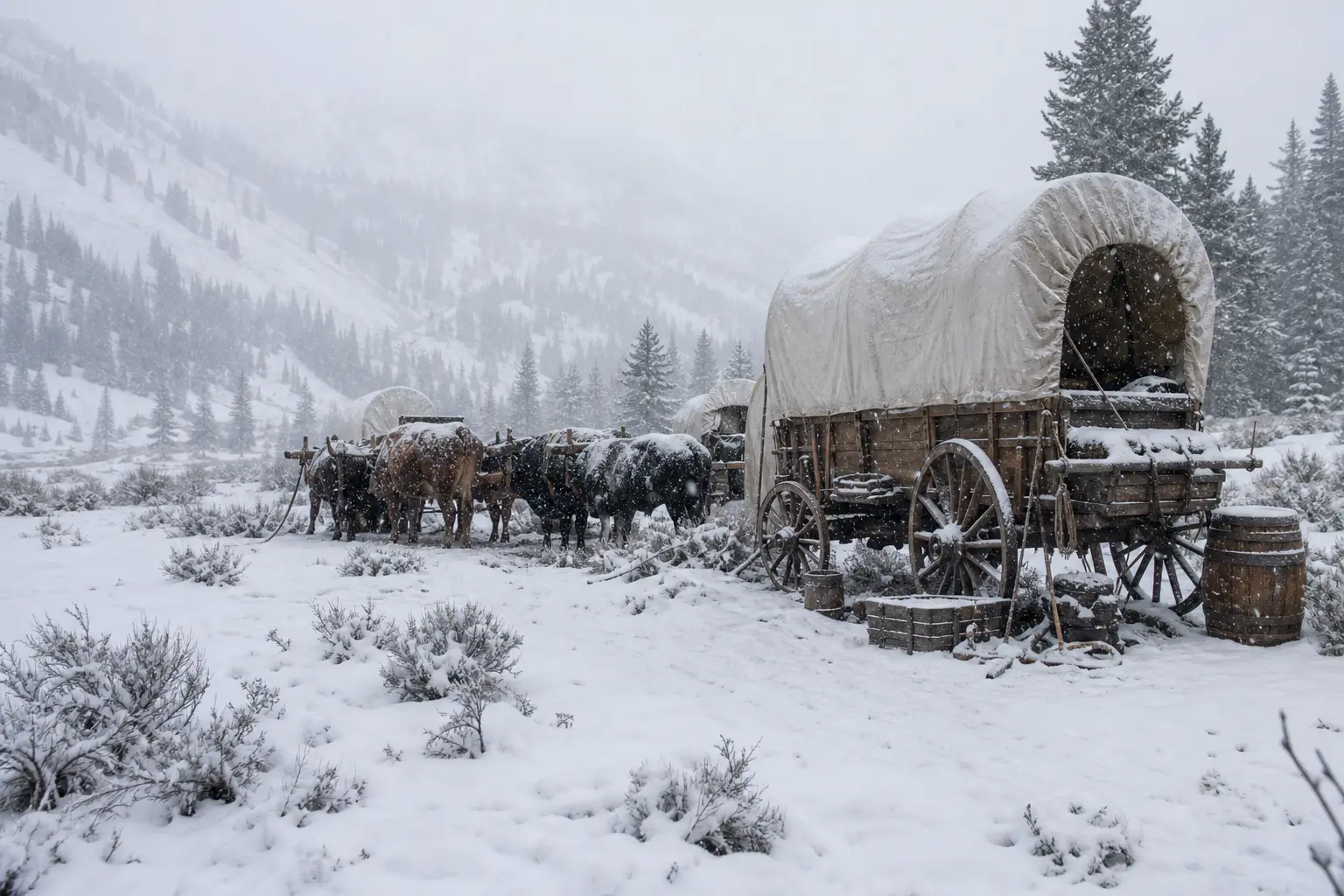
It begins as a dry whisper against the canvas, early November, 1846, somewhere on the eastern slope of what people will one day call the Sierra Nevada. You stand at the back of the wagon and catch the first flakes on the black sleeve of your coat, where they hold their shape for half a second before they melt into a gray dot. By the time you fold your arms the air has already turned strange, the way it goes still and heavy before a thing decides to fall. You think it is weather. You are wrong about almost everything that follows.
Sam, your brother-in-law, leans on his axe and watches the pass the way a man watches a locked door he has decided to try anyway. Hannah is already tearing old shirts into strips inside the wagon, because Hannah has a gift for looking at trouble and quietly beginning the mending. Morrison, sick with the flux these three weeks, is asleep under a pile of blankets and does not hear the snow start. You stand there with the taste of pine smoke in your mouth and you do the arithmetic in your head, the same arithmetic every emigrant does when the first real snow arrives a month early. There are thirty-one of you. There is wood for maybe a week. And the summit, when you last saw it through the pines, was already white.
You Cannot Outwalk a Mountain Snow
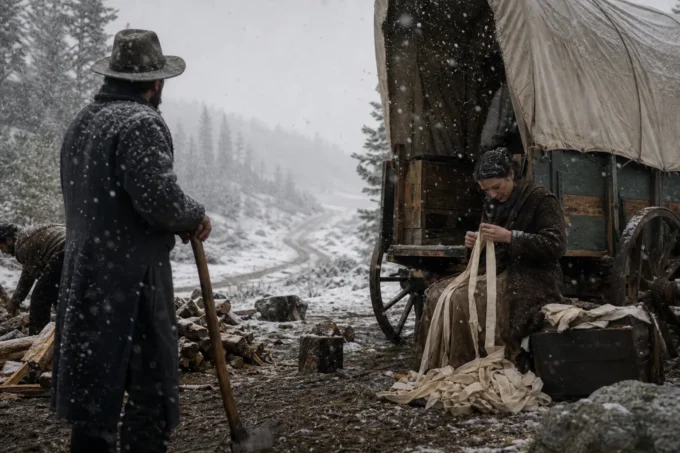
By the second morning the snow is past your boot tops and still coming down, thick and sideways, and the trail has become a rumor under it. The oxen stand with their heads down and their backs crusted white, and you understand what the old hands back at Fort Bridger meant when they told you the mountains are the only stretch of this road that will kill you for hesitating. A prairie storm you can sit through. A mountain snow you have to meet before it closes, because once the pass is drifted there is no going over it and no going back, and the only real choice left is where you dig in.
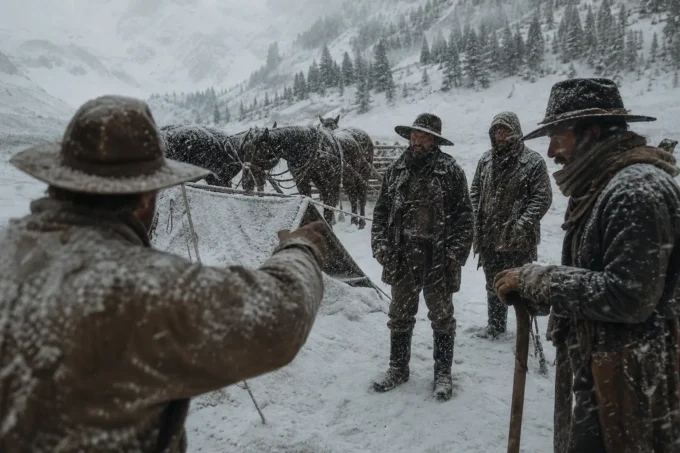
Two of the company want to push on and try the summit today. You look at them, at the wet wool and the dark circles and the way the younger one keeps stamping his feet, and you know they are already half-frozen and do not feel it yet. That is the thing nobody tells you about cold: it lies. A man loses his toes hours before he stops feeling them, and he argues about the road while the frost works up his wrists. You vote to stop. Sam votes with you. The two restless men swear and throw a shovel, but they stay, because deep down they are afraid of the pass too and they need somebody else to say the word first.
Digging In Where There Is Nothing to Dig With
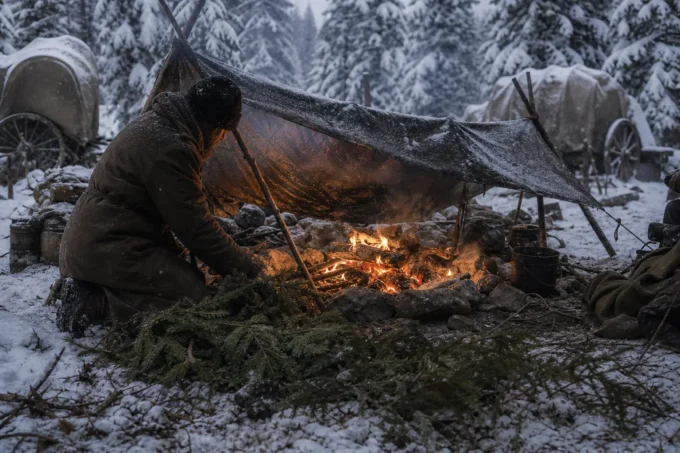
You pull the wagons into a loose ring against a wall of pines and you start to make a camp that has to last, and the first hour is spent learning that almost everything you own is the wrong thing for snow. Tents are meant for rain and wind, and wet snow piles on them until the poles bow and the canvas tears. Blankets soak through. Boots leak at the seam. The fire you build sinks into the snow until you lay down green poles and bark as a floor, and even then it hisses and smokes and tries to die every time the wind shifts. You feed it pine limbs you have to break with your hands because the good wood, the dry wood, is already burning inside somebody else’s wagon.
Slowly, badly, you do the things that keep people alive in snow. You bank the fire high with earth and stones so the heat throws forward instead of up. You cut boughs and pile them thick under every blanket, because cold comes up through the ground before it comes down through the sky. You stake an oilcloth over the fire like a low roof so the heat gathers in one place instead of running away into the dark. You put Hannah and the children nearest the coals and the sleeping arrangements stop being about comfort and become a slow, grim rotation, because the warmest corner at the center of the ring is a resource now, the way flour is a resource, and you spend it where it keeps a pulse going.
Morrison dies that third night. It is the flux and the cold together, and by the time you dig him out of the snow in the morning he is lighter than a man his size has any right to be, and his hand, when you go to move it, is stiff as a bundle of kindling. Nobody says much. You wrap him and lay him under a drift where the ground is too frozen to break, and Sam marks the spot with a stick and says a few words that the wind eats before they reach you. You do not want to end up like that, and for the next week every small task you do, every layer of boughs, every turn of the fire, is done with Morrison’s frozen hand in the back of your mind.
What Snow Does to a Body and a Company
The cold is patient in a way no other enemy on this road has been. The days blur together and you learn the signs the way you once learned to read a river. Frostbite starts white and hard at the fingers and toes and the tops of the ears and the tip of the nose, and the first warning is not pain but the strange absence of it, the feeling that a hand does not quite belong to you anymore. You catch the restless men chafing their first frozen fingers with snow, and you make them stop, because in the snow countries you rub and beat life back with warm skin and warm water and wool, and you never, ever rub with snow, which only drives the cold deeper and turns a wound into a loss.
Food goes next, because there is less of it than you admitted out loud. The oxen and cattle starve in the deep snow long before the people do, and the first of them you kill and butcher when the meat is still worth saving. The meat freezes so hard you cannot cut it with a knife and have to saw it, and the smell of it cooking, in that frozen ring of wagons, becomes the only good thing that happens in a day. You ration it by finger-width and you watch everybody else do the same, and you notice that hunger makes even decent people count each other’s portions, which is a thing you file away and try not to do yourself.
And then the thing that nobody says out loud begins to get said in looks. The horses. There are three of them left, thin and wild-eyed, and you all know what horses are when the oxen are gone and the flour is gone and the snow shows no sign of letting up. You catch Sam looking at them the way he used to look at good timber. Nobody has said the word yet, but the word is in the camp like the cold is, and you understand that the drop from “we would never” to “we did what we had to” is not a cliff at all. It is a slope, and the snow has been pushing you down it one degree at a time.
What Was Real
The Oregon and California trails moved between 1841 and 1869 something like four hundred thousand people across a continent, and the mountains were the stretch that separated the merely difficult from the fatal. The emblem of that danger is the Donner Party, which left the Midwest in the spring of 1846, took a supposed shortcut called the Hastings Cutoff, and reached the Sierra Nevada so late that early, heavy snows trapped them in the mountains in November. Snowbound for months at Truckee Lake and Alder Creek, the party lost thirty-five of its roughly eighty-one members, and the survivors became famous for the lengths to which starvation drove them.
What killed people in those snows was rarely a single cause. It was the stacking of cold, hunger, exhaustion, and bad decisions. Cold crept through wet wool and thin blankets, because nineteenth-century emigrants dressed in layers of wool and leather rather than the insulated synthetics of later centuries, and wet clothing pulled heat out of a body far faster than dry. Frostbite, recognized then as “frostbite,” was feared and poorly treated, and the folk practice of rubbing frozen skin with snow was precisely wrong, because it froze the tissue further instead of thawing it. Fires were banked high with earth and snow walls to throw heat forward, boughs were piled as insulation between bodies and the frozen ground, and tents were reinforced or abandoned for brush shelters because snow, unlike rain, bore down on canvas until it collapsed.
The peaks that trapped the Donners were the Sierra Nevada, whose name is Spanish for “snowy mountain range.” The Hastings Cutoff and a late start cost the party weeks, and by the time they reached the mountains in late October and early November 1846, the passes that might have carried them through were already closing. Their tragedy was singular, but the same arithmetic of a late start, an early snow, and a pass that will not wait played out in smaller, quieter ways all along the trail. The people who survived the mountains were the ones who understood, before the first flakes fell, that a mountain snow is not weather you sit out. It is a door that closes, and you meet it before it does, or you dig in and wait while the cold does its slow, patient work.