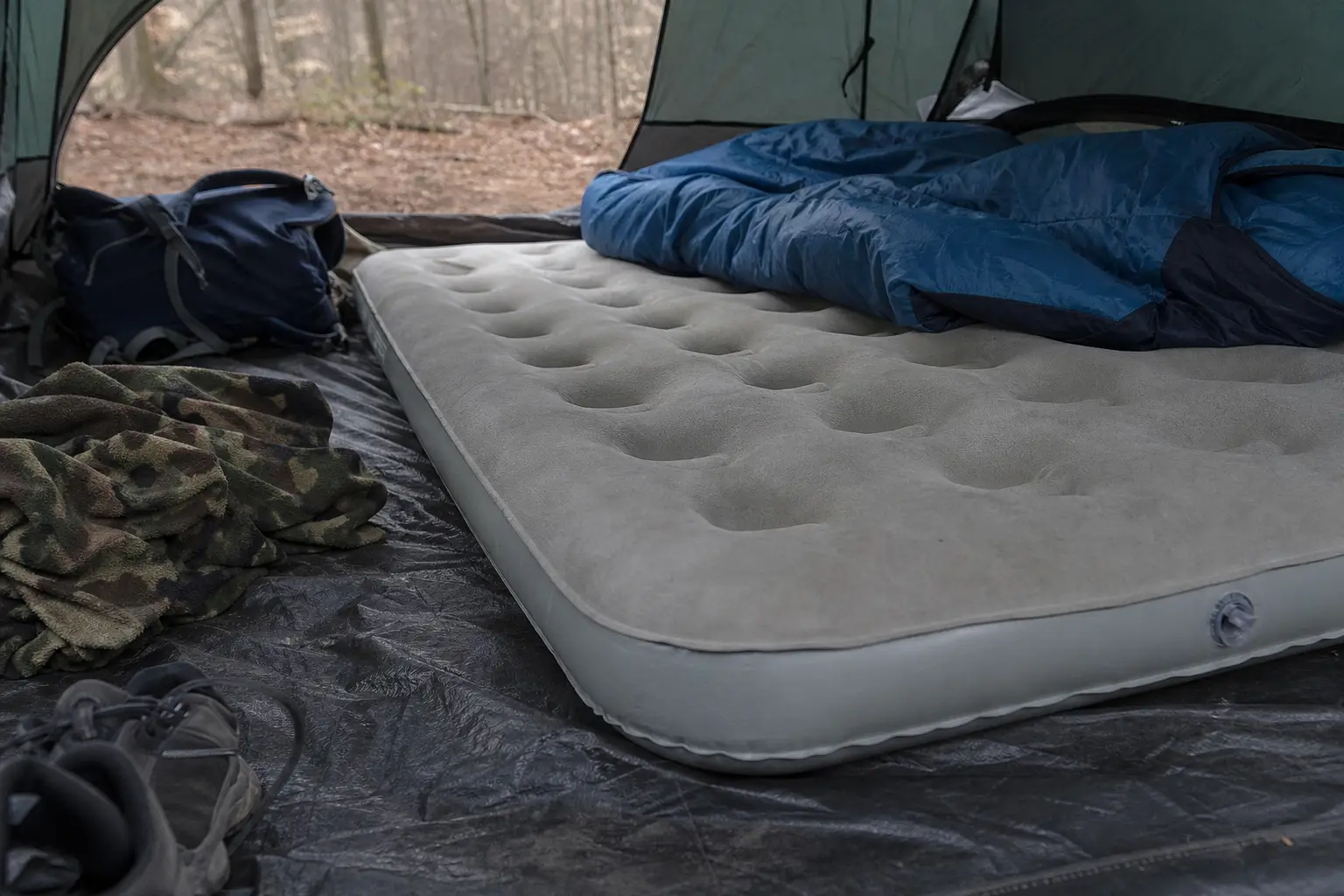
I froze my own kid on a Cub Scout camping trip last weekend and it took me three days to admit the mattress did it. Not the sleeping bags. Not the weather. The mattress, which I bought at a big-box store six years ago for forty dollars and never thought about again.
Here is how confident I was. I packed wool socks for both of us. I packed sweats and hoodies and two T-shirts each. I threw a duvet on top of the pile for good measure. The temperature was supposed to hit the mid-forties, and I am a grown man who owns a tent, so obviously I had it handled. My son is eight. He trusted me the way an eight-year-old trusts his dad on the drive out, which is to say completely and without a single follow-up question.
We shivered all night. Both of us. I kept waking up cold, checking the zipper on my bag, yanking the duvet back over my shoulders, and every time I dozed off the cold came up through my back like somebody left a window open under the tent. Around three in the morning my son whispered that his toes were cold, and I whispered back to just tuck them into his bag, and he whispered that they were already tucked, and I lay there feeling like the worst scoutmaster on earth and did not sleep again until the birds started.
The Air Mattress Was Eating Us
I figured it out the next day from a stranger on the internet, which is not a sentence I enjoy writing. Somebody on a gear forum, right after telling me I was an idiot in the friendliest possible way, wrote one line that rearranged my whole understanding of sleeping outdoors: the air inside your air mattress matches the air temperature, and your body heat never catches up.
Think about it for two seconds. You are not sleeping on a cushion. You are sleeping on a balloon full of cold night air, and that balloon is in direct contact with the cold ground on one side and your warm back on the other. Your body spends the whole night trying to heat forty-five-degree air, losing to the ground the entire time. A sleeping bag only insulates where it can loft underneath you, and under a body that loft is crushed flat to nothing. So the bag was doing next to nothing between me and the cold, and I was doing my best impression of a frozen pork chop on a cold air pillow.
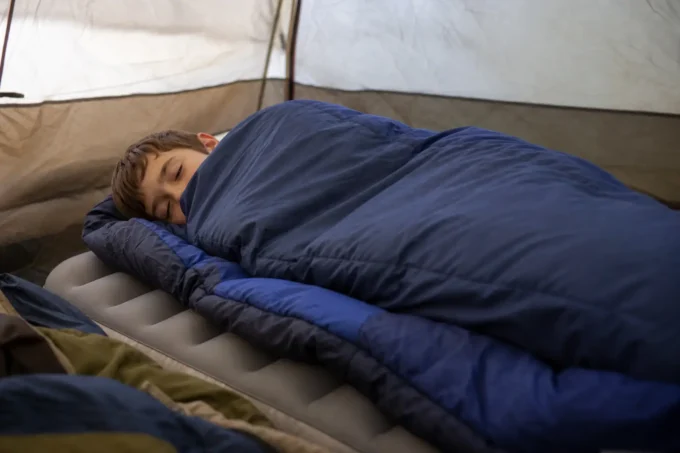
The idiocy goes deeper, because of course it does. My son’s sleeping bag was an adult size. I bought it big on purpose so he could grow into it. What I actually did was hand an eight-year-old a sack with three feet of empty dead space that his little body had to heat all night before the bag would do anything for him. He was sleeping in his own personal wind tunnel with a hoodie on.
What I Learned About Cold the Hard Way
Once I stopped being defensive about it, the fix was embarrassingly simple, and cheap, and it would have worked the very first night if I had spent ten minutes thinking instead of forty dollars feeling prepared.
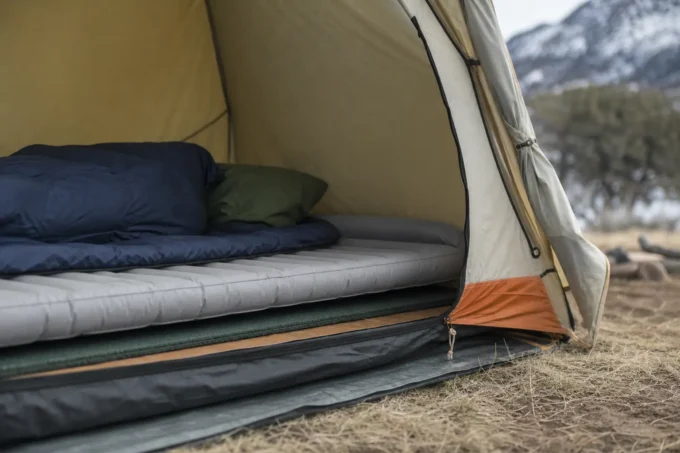
- An insulated pad is the single most important piece of your sleep kit. Cold comes from below, and an air mattress is a cold transfer pump, not a bed. You want a pad with an actual R-value. Somewhere around R2 to R3 gets you down to the forties without fuss, and it does not have to be expensive to work.
- Sleeping bag ratings are survival numbers, not comfort numbers. When a bag says 40 degrees, that means you will probably survive 40 degrees and be miserable the whole time. Buy something rated ten or fifteen degrees colder than the coldest night you actually plan to sleep through.
- A kid in an adult bag is a kid with a cold body. Fill the extra space with clothes or a blanket at the foot, or just get a bag that fits. All that dead air has to be heated before the bag helps him at all.
- A cheap closed-cell foam layer works wonders. Even a yoga mat or a third of an inch of packing foam between you and the air mattress breaks the contact and keeps your heat on your side. It is ugly, it is indestructible, and it costs almost nothing.
The part that still stings is that I own closed-cell foam pads already. They are stacked in a tote in the garage under the Christmas decorations. I just did not think I needed them, because I had a real air mattress, and real air mattresses are what people who camp seriously use. That is the exact kind of wrong that feels like knowledge because it is smooth and confident and it comes out of my own mouth.
The Second Night Went Better
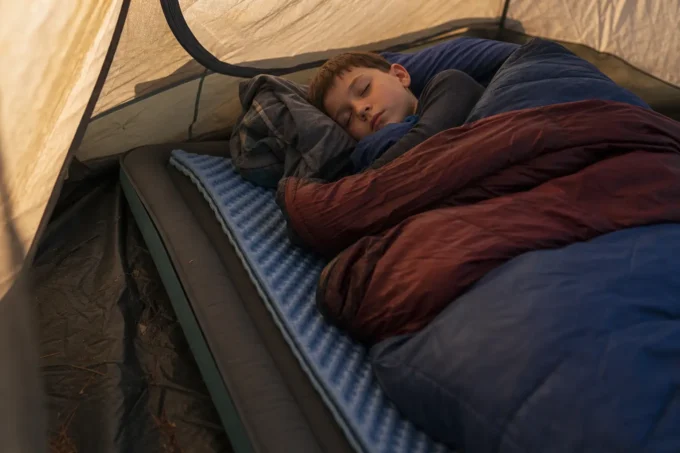
I did not fix everything overnight. I bought a cheap insulated pad with a real R-value and a foam topper for the air mattress, and I stuffed the bottom of my son’s bag with a spare fleece and a rolled towel. The second night the low hit forty-one and neither one of us woke up cold a single time. My son slept through, which is the only review of my gear that has ever mattered to me.
He still talks about the trip like it was an adventure, because that is what eight-year-olds do. They remember the campfire and the s’mores and the raccoon that knocked over the cooler, and they file the cold under “thing that happened” and move on. I am the one who keeps replaying three in the morning, the two of us lying there in our expensive sleeping bags on top of a forty-dollar balloon, me whispering that it would be fine when neither of us believed it.
The Bottom of the Tent Is the Whole Game
If you take one thing from my idiocy, take this. When you are cold in a tent, look down before you look at your bag. Insulation underneath you is worth more than another layer on top, because the ground is the biggest heat thief in the whole setup and it works all night for free.
An air mattress is a summer toy doing a winter job. A pad with an R-value is a tool. And a sleeping bag too big for the body inside it is a sack with a space heater problem. None of this cost me much more than the forty dollars I was so proud of, and all of it would have kept my son’s toes warm at three in the morning while I lay there blaming the weather.
The weather was fine. I was the broken gear.