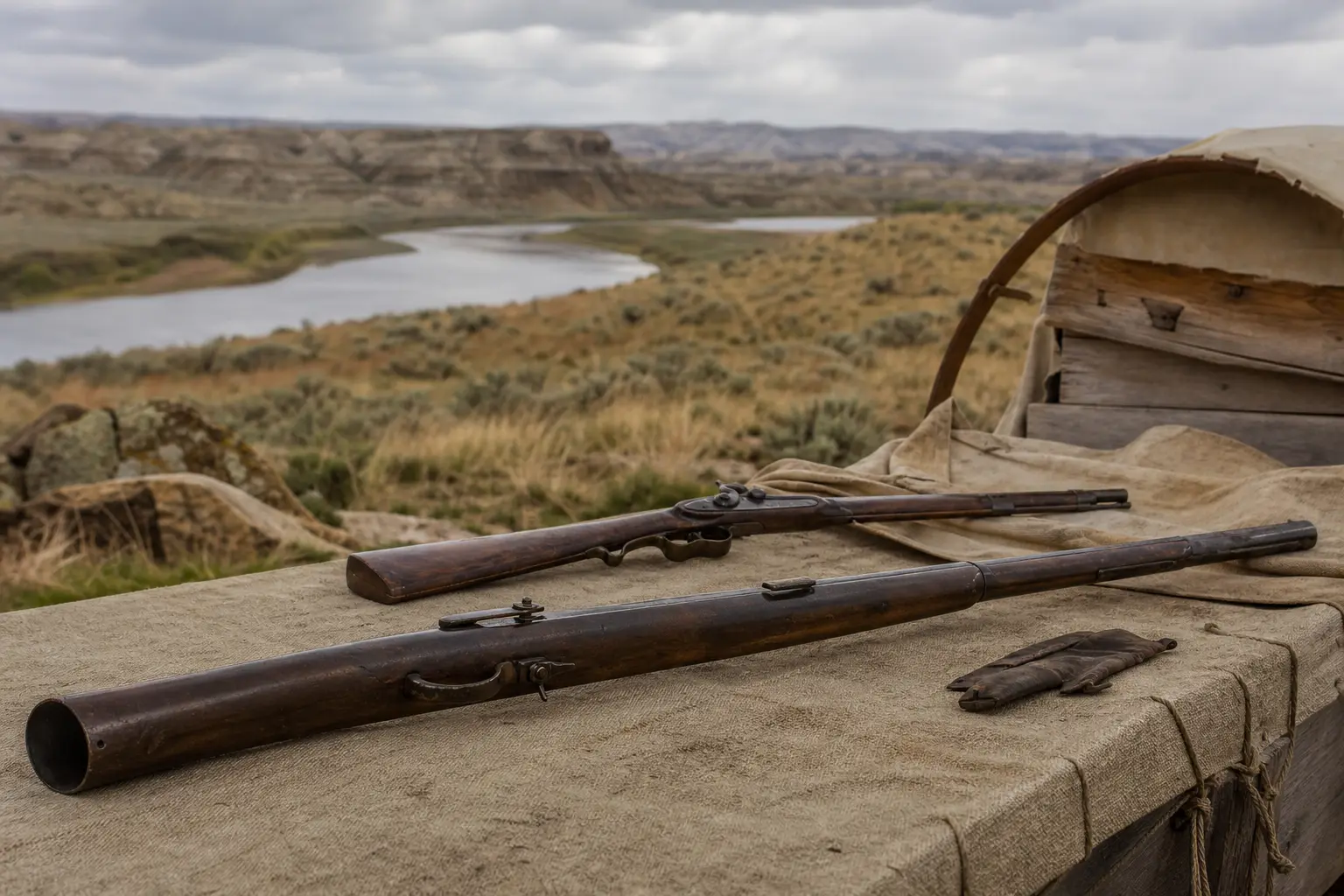
Late May, 1848. Somewhere on the North Platte, a Day East of Fort Laramie.
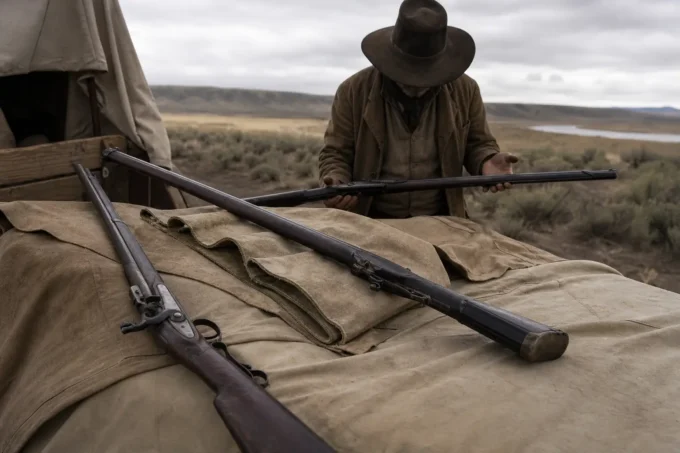
You wake because Sam is already awake, which almost never happens, and he is standing over the wagon box with your father’s smoothbore laid flat across both palms the way a man holds something he has stopped trusting. The morning is cool and gray and smells of wet sage and buffalo chips gone out. “She’s fouled,” he says, not looking at you. He means the long trade fowler you have carried from Missouri because it is what your family always carried, a heavy-barreled smoothbore that throws a ball or a handful of shot and asks no questions of distance. Next to it on the folded canvas sits the Hawken, clean and oiled and heavy as an anvil, the rifle your brother Thomas saved two winters to buy and then handed you when the flux took him below the Sweetwater last June. You have both guns. You have been on the trail long enough to know you cannot carry both forever and short enough to still think there must be a way to.
Two Guns, One Man, and a Decision the Prairie Will Force Either Way
The smoothbore is a lover, not a fighter, and you know it the way you know your own hands. It will take any bird that rises, any rabbit that bolts, a squirrel, a grouse, sometimes a deer at forty yards if you shoot it in the chest and pray a little. It is forgiving about powder, forgiving about shot, forgiving about a man whose heart is hammering because dinner is running. The Hawken is none of those things. The Hawken is a promise aimed at one animal, far away, that ends with meat in the wagon or an empty pan and a clean miss you will think about for a week. You cannot feed the heavy rifle from nothing. You cannot eat birds with a wink and a wave. And up ahead is Fort Laramie, where a man’s last coin spends once and where the men who have come back down the trail all say the same thing in a hundred different tongues.
What the Men Coming Back Tell You
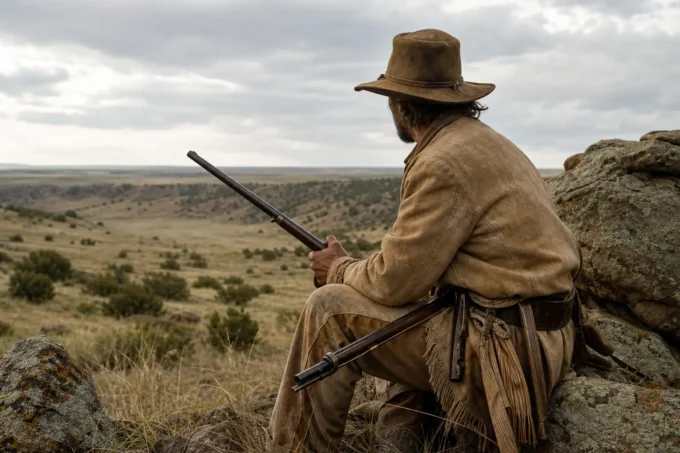
Morrison told you before the flux closed his throat. He said the smoothbore is for the country you already know, and you are leaving that country behind at every camp. A prairie is not a woodlot, he said. There is no brush to hold a shot close. A deer out on the open flats does not stand at forty yards and wait for your handful of shot to catch up; it starts walking when it sees your boot, and it is at two hundred before you have the butt to your shoulder. The game here comes in two sizes, he said, and by that he meant the small things that run past your feet and the big things that stand out past where the smoothbore can honestly reach. A man can eat the small ones, but a family eats the big ones, and a big one at two hundred yards does not care how many fathers carried your smoothbore before you. Morrison always grinned when he said the hard part, like the truth was a joke he had heard too many times, and then he said the line you keep turning over: the rifle is a slow gun for a fast country, and the smoothbore is a fast gun for a country that is about to be gone.
The Cold Arithmetic You Do at the Fire
You lay it out while Hannah feeds the fire and the Miller boy watches you the way the young watch men doing sums. A pound of lead casts twenty-four balls for the Hawken, or eight or nine loads of shot for the fowler. A pound of powder throws roughly forty rifle charges, or maybe twenty-five to thirty smoothbore loads, depending on how heavy you pour. The Hawken will drop a buffalo cow clean at a hundred and fifty if your hands are steady, and one buffer is meat for the whole wagon for a month if you can dry it. The fowler will take four or five grouse in a morning if you can find them, and a man on a prairie does not find four or five grouse every morning. The rifle earns its powder on one animal. The smoothbore spends its powder on chances. That is the whole of it, and you hate that the arithmetic is not on the side of the gun that remembers your father. Sam knows it. He has known it since the first morning the flats opened up and there was no tree line to hide the distance. He holds the fowler on his palms because he is waiting for you to say it out loud so he does not have to.
The Trade, and the Man Who Watches It
At Fort Laramie you trade the smoothbore to a man headed east who has more luck than sense and a longing for a gun he can feed with whatever he picks up. He gives you a small keg of powder, a bar of lead rough as a fist, and a leather pouch of caps, and he leaves with the fowler across his shoulder like a man who has won something. You do not correct him. You watch him go and you feel the weight of the Hawken settle onto your shoulder as if it had been waiting to own you. The Miller boy asks if you sold your father’s gun, and the question lands heavier than the keg of powder, because you did sell it, and you sold it to a man going the wrong direction, and some part of you thinks your father would understand and some part of you thinks he would reach for the smoothbore he is no longer alive to hand you. You think briefly about people back east sitting on a porch with a fine fowler and a full woodshed and no idea that the country is wider than the reach of everything they love. Then you shoulder the heavy rifle and walk out of the post the way everyone walks out, into a country that has already decided which gun a man becomes.
What Happens Two Hundred Miles Later
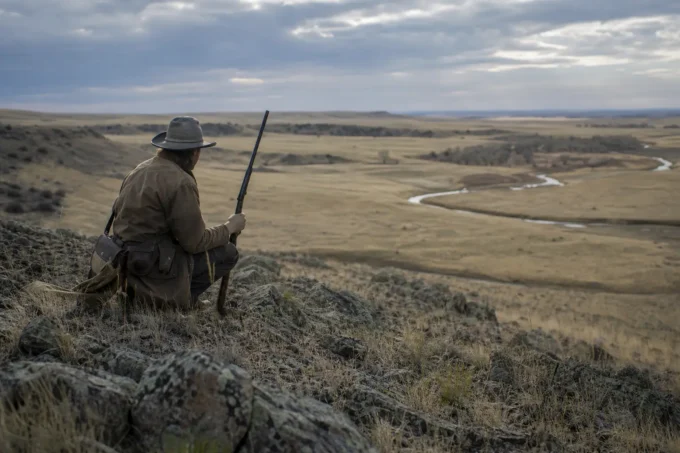
The Hawken fails you once, and it is exactly where Morrison said the smoothbore would have failed you a hundred times. A coyote crosses a draw at ninety yards, thin as a lie, and you shoot and the ball knocks the air where it stood. That is the cost of the slow gun: every miss is a mile of powder walked out and spent, and the coyote does not come back to be shot again. But the next week a buffalo cow stands broadside at a distance you would have sworn was impossible, and the Hawken speaks, and the cow folds like a curtain dropping, and you walk up to more meat than you have seen in your life. That is the gun earning the whole trade in one animal. Hannah said nothing then, but she worked beside you until after dark, and you understood that her silence was a verdict. The fowler would have still been hungry. The rifle made the wagon heavy with meat down to the hubs. You never once look back at the smoothbore without knowing you made the only choice the open country leaves a man.
What Was Real
The choice between a smoothbore and a rifle was one of the oldest and most lived decisions on the overland trails. The smoothbore fowler, or trade musket, was the workhorse of the eastern woodlands, a gun with no rifling inside the barrel that could throw a round ball or a charge of birdshot, cheap to shoot, forgiving to load, and fatal only at short range. The Kentucky rifle and later the Hawken were rifled guns that spun a round ball so it flew straight at distance, but they used more lead and took longer to load and clean. On a prairie with no cover, distance became everything. Game out on the open flats simply did not let a man get close, so the rifle won the argument not on theory but on reach. A Hawken rifle weighed ten or eleven pounds and could take a buffalo or a deer clean at a hundred and fifty yards or more; a fowler was lucky to kill a deer beyond fifty. The real cost of each was powder and lead: roughly twenty-four round balls to a pound of lead, forty or so rifle charges to a pound of powder, while a smoothbore burned powder faster on scattered smaller game. Many emigrants who started with eastern fowlers traded or sold them at Fort Laramie or Fort Bridger, switching to a rifle for the buffalo country and the open high plains, because the animals that fed a family there were the large ones, and they stood far past where a smoothbore could honestly reach. The heavy rifle became the emblem of the western hunter for exactly that reason: a slow, expensive gun for a fast, wide country that gave a man only long shots or none at all.