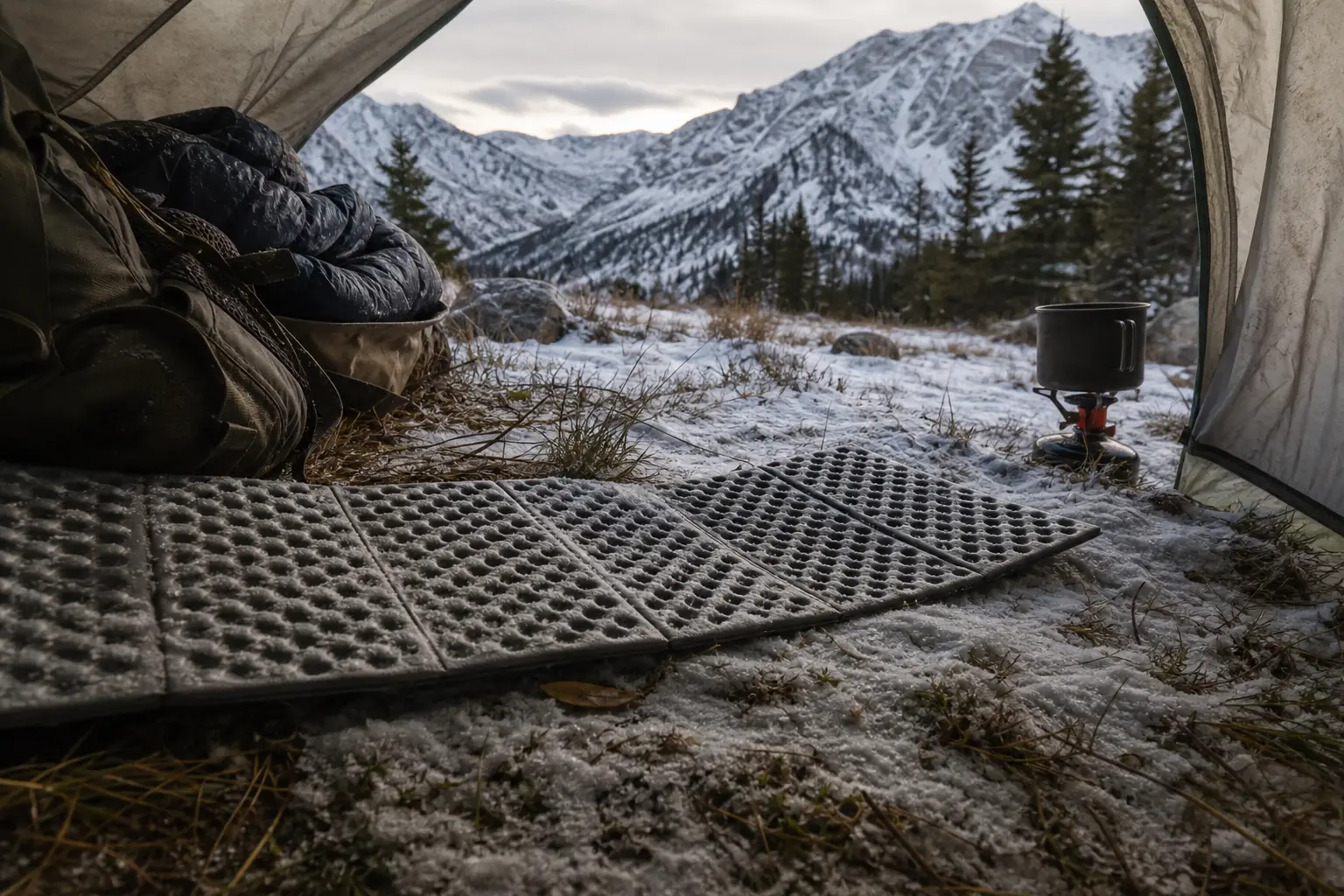
I carried the same folding foam pad for eleven years. It cost me nineteen dollars at a surplus store in 2015, and I have since used it as a seat, a stove windbreak, a boot mat, a splint, a knee pad for changing a tire on gravel, a dog bed, and a folded shim under one wobbly leg of a card table. It has never once gone flat on me, because there is nothing in it to go flat. When people at trailheads brag about their three-inch inflatable pads with an R-value of six, I have always looked at my nineteen-dollar foam and felt the quiet superiority of a man who owns something that cannot break. I was right about that part. I was wrong about almost everything else, and I spent a lot of cold nights finding out.
The first lie I told myself was that a pad is a pad. Foam is foam. The ground is cold, a pad sits between you and the ground, done. I have now read enough to know that the thing my pad was supposed to do is called blocking conduction, which is a fancy way of saying heat leaks out of your body into the dirt the same way water soaks into a dry sponge, and if you do not put enough dead air between your warm back and the cold earth, the earth wins every single time. The earth is patient about it. It will pull heat out of you all night for free and never get tired. A thin foam pad is a suggestion. The ground does not take suggestions.
The Nights I Refused to Understand
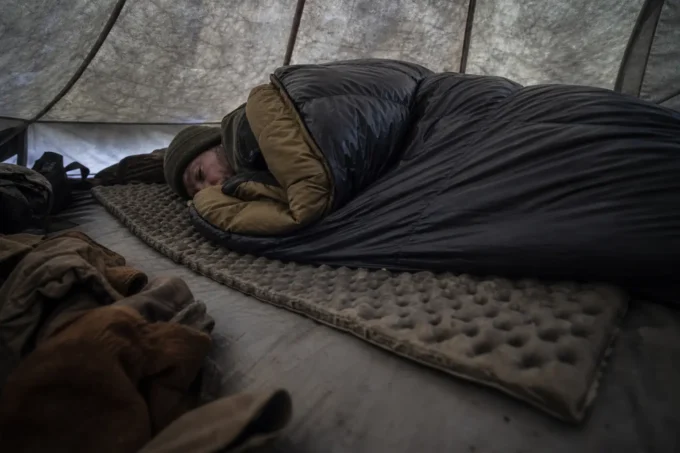
Every October it went the same way. I would drive to the mountains for a late-season hunt, sleep fine the first two nights when the thermometer still said forty at midnight, and then a front would come through and drop it into the twenties and I would lie there until three in the morning trying to solve the problem with gear I did not own. I tried wearing more clothes inside the bag. I tried a thick wool sweater and two hats. I tried my rain jacket on top of everything because I had read somewhere on a forum that vapor barriers keep you warm, and I woke up at 2 a.m. sweat-soaked and then colder than before, which is what a vapor barrier does when you use it wrong and too late in the season. I tried curling into a tight ball. I tried flexing my calves for warmth like I could out-hustle physics.
None of it worked, because none of it touched the actual problem. The actual problem was lying directly under my spine and ribcage, a nineteen-dollar piece of foam that I had been pressing flat for eleven years. Foam packs out. It loses its loft, the little air cells that did the insulating collapse under eleven years of my body weight, and the pad I started with was thin to begin with. By year eight it was doing the work of a folded newspaper. But I would have argued with you about it, because admitting the pad was the problem meant admitting I had bought the wrong thing and carried it proudly for a decade, and my pride was better insulated than any pad I owned.
The Space Blanket I Was Convinced Would Fix It
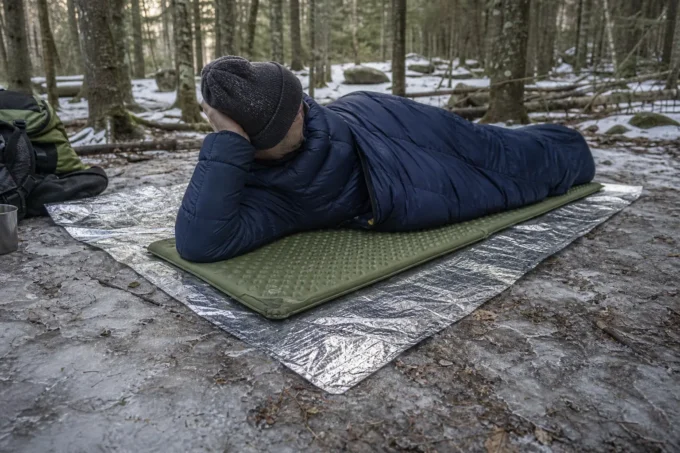
One winter I decided the answer was an emergency blanket under the pad. This felt clever. I had a silvery crinkly sheet in my truck kit and I figured that if it reflects heat when you wrap it around a cold person, it would reflect heat when you put it under a sleeping pad. I spread it under the foam like tinfoil under a casserole and slept exactly as cold as ever, and I could not figure out why. I looked it up later, properly this time, and the answer is embarrassing. A space blanket reflects radiant heat, and it only does that job when there is an air gap for the heat to radiate across. Sandwich one under your pad with your body on top and there is no gap, so there is nothing to reflect. The cold ground does not care what color your foil is. Conduction goes right through it like the foil is not there. I had been sleeping on a bright idea instead of insulation, and my back paid the bill.
What finally flipped me was not the cold. I had grown up cold and could always out-stubborn a bad night. What flipped me was a stranger on a gear forum telling another man, one who asked how to make a thin foam pad warmer, that stacking the pads actually works, because R-value is additive. Not clever. Just additive. One pad with an R-value of two, another pad with an R-value of two, lay one on the other and you are sleeping on an R-value of four. The same stranger said the part that stuck in me like a splinter: if you loved T-shirts and got cold every winter, telling you to wear twenty T-shirts would not be my first suggestion, because the coat exists for a reason. I read that line and sat there mad, because I knew exactly what I was doing. I had been telling myself a story about how tough and unbreakable my cheap foam was, and none of that toughness did a single thing for the heat leaving my back into the frozen dirt.
What Actually Works
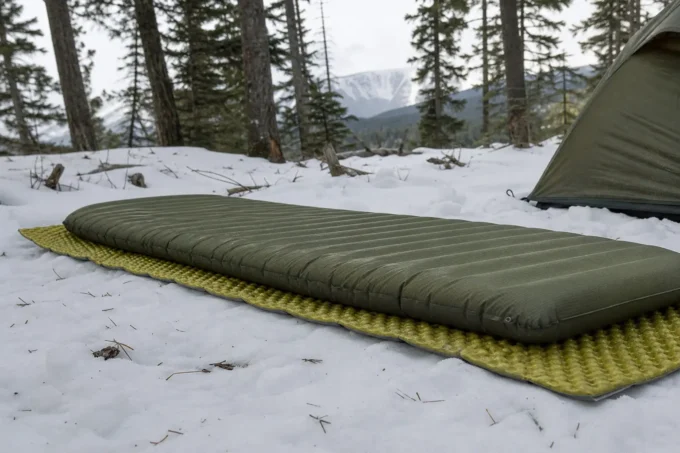
The fix was so plain it almost offended me. I kept the foam, and I added a real inflatable pad on top of it. The foam stays on the bottom because it protects the inflatable from the gravel and the pine knots and everything that would eventually put a hole in a three-inch air mattress, which was exactly the fear that had kept me away from inflatables in the first place. The inflatable does the insulating my thin foam could not. Together they are warm enough that I slept through a seventeen-degree night on snow without waking up once, which for eleven years I had told myself was a fantasy sold by the same people who wanted to sell me a pad I did not trust. It was not a fantasy. It was just insulation doing what insulation does.
The lesson I actually learned has nothing to do with pads. The pad was never the point. The point is that I had a piece of gear I loved for reasons that had nothing to do with what nights ask of you, and I made eleven years of cold nights pay for that stubbornness instead of buying one piece of gear I did not want to admit I needed. Tough and cheap are real virtues. They are not the same thing as warm, and warm is the thing the ground checks first. The ground does not care what your pad costs or whether it will survive being run over by a truck. It only cares whether there is enough dead air between you and it. There was not, for a long time, and that is no one’s fault but mine.
Keep What Works, Fix What Doesn’t
If you sleep cold and you love your foam pad, keep it. Put an inflatable on top and let the foam be the armor. If your pad is more than a few years old and has collapsed to the thickness of a placemat, replace it, because packed-out foam is doing nothing for you no matter how many layers of clothing you pile on your chest. Do not bother with the space blanket under the pad; the physics does not care how shiny you are. And the next time you catch yourself defending a piece of gear because it has never let you down, ask yourself the honest question: never let me down at what, exactly. A pad that has never gone flat is not the same as a pad that has kept me warm. I spent eleven years proud of one while lying on the other. The ground taught me the difference, one February night at a time, and it charged full price for the lesson.